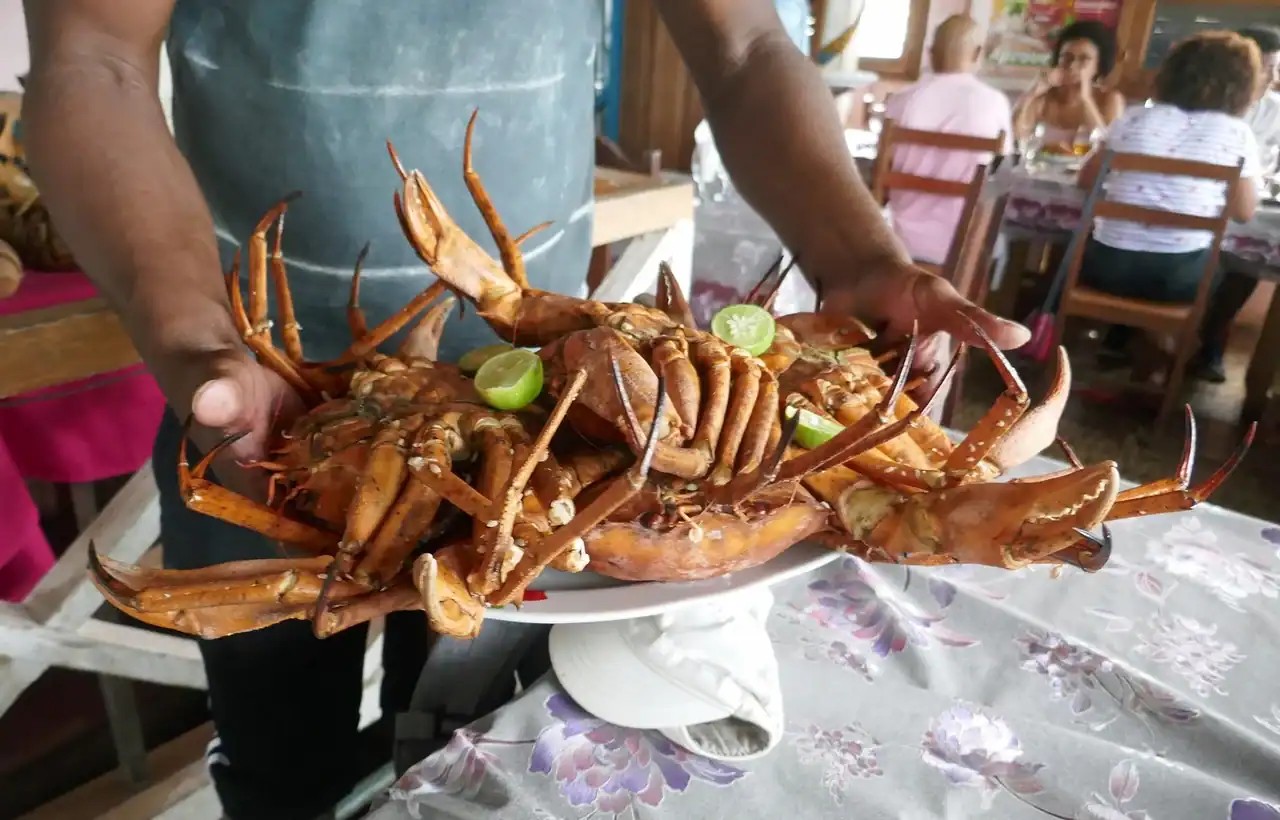
Freshly caught santola crabs in São Tomé and Príncipe

The Chocolate Islands Kitchen

Traditional São Tomé andPríncipe Recipes

Five traditional dishes from the islands, with ingredients, methods and practical substitutions for cooking at home.

Food is an important part of life in São Tomé and Príncipe. Fish, palm oil, cassava, breadfruit, matabala, vegetables, herbs and spices appear throughout São Tomé cuisine, alongside dishes shaped by the islands' history and culture.

These five recipes are a good place to start if you want to cook some of the traditional food of the islands yourself.

Recipe One

Calulu de Peixe

Calulu is one of the best-known traditional dishes of São Tomé and Príncipe. It combines smoked fish with vegetables, leaves, palm oil and local seasonings.

Ingredients

  • About 1.2 kg smoked fish
  • 250 g mussua
  • 1 bunch watercress
  • 1 breadfruit
  • 100 ml palm oil
  • 2 tomatoes
  • 1 onion
  • 5 okra
  • 2 aubergines
  • 1 bay leaf
  • 1 óssame
  • Sprig of marjoram
  • Water
  • Pepper stick
  • Salt
  • Malagueta

Method

  1. 1Chop the vegetables and put them in a pot with water, palm oil, óssame, pepper stick and salt. Cook for about one hour.
  2. 2Remove the breadfruit, mash it, then return it to the pot with some hot water and continue simmering.
  3. 3Add the herbs and smoked fish. Adjust the salt if necessary and simmer gently.
  4. 4Serve with angu, cassava flour or rice.

Substitutions

  • If mussua is unavailable, Portuguese cabbage can be used instead.
  • Smoked fish can also be replaced with smoked meat, chicken, pork or prawns, although this changes the character of the dish.

Recipe Two

Kizaca

Kizaca is made from cassava leaves that are pounded before cooking, then combined with shrimp and either palm oil or coconut milk.

Ingredients

  • Pounded cassava leaves
  • Shrimp
  • Palm oil or coconut milk
  • Onion
  • Salt
  • Water

Method

  1. 1Boil the pounded cassava leaves until cooked, then drain off the water to remove the bitterness.
  2. 2Sauté the onion and shrimp in palm oil with salt.
  3. 3Add the cassava leaves and cook for another 10 minutes.
  4. 4Serve with funge, fubá or rice.

Substitutions

  • Coconut milk can be used instead of palm oil.
  • If cassava leaves are unavailable, collard greens or spinach can be used as a practical alternative, although the flavour and texture will not be exactly the same.

Recipe Three

Pastéis de Matabala

Pastéis de Matabala are small fried fritters made from matabala, salted fish, eggs, garlic, parsley and onion.

Ingredients

  • 250 g salted fish, such as grouper, barracuda or cod
  • 200 g matabala, or taro
  • 3 eggs
  • 1 clove garlic
  • 2 tablespoons chopped parsley
  • 1 small onion

Method

  1. 1Desalt and cook the fish. Remove the bones and skin, then flake the flesh.
  2. 2Boil and mash the matabala.
  3. 3Combine the fish, matabala, garlic, parsley and onion.
  4. 4Beat the eggs and fold them into the mixture to bind it.
  5. 5Shape the fritters using two spoons and deep fry in hot oil.

Substitutions

  • Matabala is a taro-type root vegetable, so taro can be used when matabala is sold under a different name.
  • The fish can be grouper, barracuda or cod.

Recipe Four

Izaquente de Açúcar

Izaquente comes from the African breadfruit tree, Treculia africana. Its large fruit contains many edible seeds, which are used in São Tomé cooking.

Ingredients

  • Izaquente seeds, African breadfruit
  • Water
  • Salt
  • Cocoa water
  • Cinnamon stick
  • Pepper stick
  • Sugar
  • Lemon peel

Method

  1. 1Boil the seeds in water for about one hour.
  2. 2Add salt, cocoa water, cinnamon stick and pepper stick, then boil for another five minutes.
  3. 3Stir in the sugar and boil for a few more minutes.
  4. 4Whip the mixture for a creamier texture, traditionally using a cata.
  5. 5Finish with lemon peel.

Substitutions

  • There is no close substitute for izaquente seeds. They come from Treculia africana, rather than the more familiar seedless breadfruit commonly cooked for its flesh. Replacing them would produce a different dish.
  • Cocoa also has a much wider place in the islands' history, which you can read about in our history of chocolate in São Tomé.

Recipe Five

Ijogó

Ijogó combines finely shredded Portuguese cabbage with smoked fish, palm oil, tomatoes, onion, garlic and local seasonings.

Ingredients

  • 1 Portuguese cabbage, couve
  • 2 medium onions
  • 2 cloves garlic
  • 50 ml palm oil
  • 1 bay leaf
  • 3 tomatoes
  • 400 g smoked fish
  • 1 dessert spoon flour
  • Óssame
  • Pepper stick
  • Water
  • Salt
  • Piripiri

Method

  1. 1Shred the cabbage finely, as for caldo verde, and boil it in salted water.
  2. 2Separately, heat the palm oil in a pot with the chopped onion and garlic, bay leaf, skinned and deseeded tomatoes, crushed pepper stick and óssame, salt, piripiri, and the smoked fish after removing its skin and bones.
  3. 3Bring to the boil, adding a splash of water if needed.
  4. 4Drain the cabbage and mix it into the pot.
  5. 5Return to the heat and cook until the mixture has reduced and there is no sauce left. Serve with white rice.

Substitutions

  • If smoked fish is unavailable, fresh fish can be dried slowly in a low oven before using it in the recipe.
  • Óssame and pepper stick are characteristic São Tomé ingredients. If they are unavailable, leave them out rather than replacing them with unrelated spices.
Made with AI in Macaly