São Tomé and Príncipe culture is rooted in isolation and mixture. For five centuries, the islands sat at a colonial crossroads without ever quite fitting European or African categories. What emerged was something specific, syncretised and still evolving.
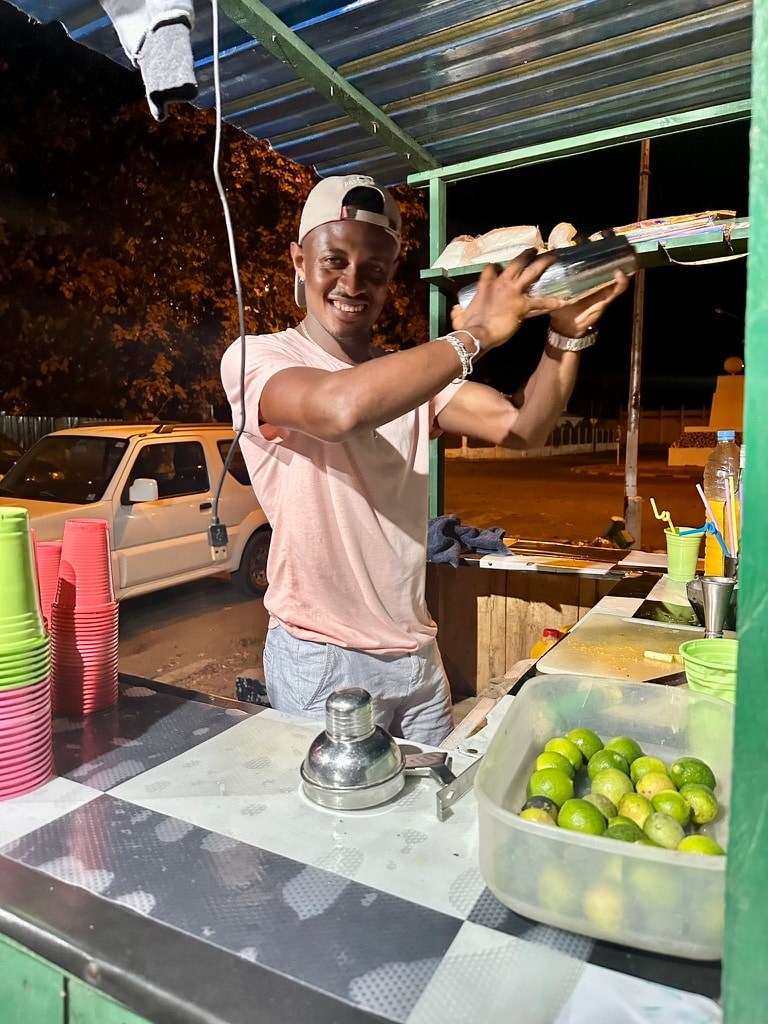
If you arrive expecting performance culture or staged authenticity, you will be disappointed. What you encounter instead is quieter: market rhythms, street-side grilling, elderly men playing draughts under a tree and conversations that unfold in Forro, Portuguese and sudden bursts of pidgin English. It is not picturesque. It is lived.
This guide explains what shapes daily life here, how culture operates and what visitors might notice if they slow down long enough.

Leve leve: the pace of island time
Leve leve translates roughly to "easy, easy" or "slowly, slowly", but it functions more as a cultural shorthand for how things work here.
Meetings start late. Shops close unexpectedly. A ten-minute task stretches into an hour. None of this is inefficiency in the pejorative sense. It is structural realism. Public infrastructure is limited. Supply chains are fragile. Power cuts interrupt business hours. The island runs at the speed its systems allow.
For visitors, leve leve manifests as frustration or release depending on expectation. If you arrive demanding timeliness and efficiency, São Tomé will exhaust you. If you adjust to its rhythm, you will notice how much social life happens in the gaps: neighbours catching up while waiting for a delayed taxi, children playing football in a roadside clearing, the slow accumulation of conversation that constitutes community here.
It is not romantic. It is adaptive. In a place where formal employment is scarce and systems are unreliable, leve leve is how people negotiate unpredictability without losing sanity.
Language: Forro, Portuguese and the politics of code-switching
Portuguese is the official language, but it is not the mother tongue for most Santomeans. That distinction belongs to Forro, a Portuguese-based creole that emerged on the plantations and became the vernacular of the islands.
Forro is expressive, rhythmic and structurally distinct from Portuguese. It borrows from Kimbundu, Kikongo and other Bantu languages that enslaved Africans brought with them. To hear it spoken is to hear the islands' history compressed into syntax and intonation.
In the city and among educated Santomeans, Portuguese dominates public life. But step into the markets, the rural villages or family homes and Forro reasserts itself. The choice of language is never neutral. It marks class, education, geography and sometimes intent.
Visitors will encounter Portuguese in official contexts, hotels and tour operators. Elsewhere, especially in rural São Tomé, expect Forro. English is increasingly common among younger people in the capital, but it is not widespread. Bring patience, a phrasebook and an awareness that linguistic fluency here involves more than vocabulary.
Food: calulu, grilled fish and the politics of palm oil
Santomean cuisine is not refined, but it is functional, adaptable and grounded in what the island provides: fish, breadfruit, plantain, cassava and palm oil.
Calulu is the national dish: a thick stew made with smoked fish or dried meat, vegetables and palm oil. It is heavy, rich and polarising. Either you appreciate its intensity or you do not. There is no middle ground.
Grilled red snapper is ubiquitous and usually excellent. Street vendors cook it whole over charcoal, served with rice, beans or fried plantain. This is daily food for most Santomeans and it is where you will eat best if you know where to go.

Palm oil is everywhere: in sauces, stews and fried dishes. It is not subtle. If you have dietary restrictions, allergies or strong preferences, communicate them clearly and early. Vegetarian options exist, but they are not instinctive here. Meat and fish dominate the culinary logic.
For more on where to eat and what to expect, see the food guide.
Music: puita, ússua and contemporary evolution
Santomean music is percussive, polyrhythmic and rooted in labour songs that originated on the roças.
Puita is the most distinct traditional form: a friction drum ceremony that involves call-and-response singing, dancing and improvisation. It is communal, participatory and primarily performed during festivals or weddings. You will not encounter it as a tourist unless you are invited.
Ússua is gentler: a rural dance tradition performed in circular formations with handclaps and vocals. Both puita and ússua are fading as urbanisation draws younger generations into the capital and away from village life.
Contemporary Santomean music blends African soukous, Angolan kizomba and Brazilian influences. Live performances happen sporadically in the city, usually at outdoor venues or cultural centres. Do not expect a thriving nightlife scene. Music here is seasonal and tied to specific events.
Tchiloli: theatrical tradition and historical memory
Tchiloli is São Tomé's most distinctive cultural expression: a syncretic theatre tradition that fuses 16th-century Portuguese drama, African performance styles and colonial power dynamics.
The story derives from The Tragedy of the Marquis of Mantua and the Emperor Charlemagne, a medieval chivalric tale that Portuguese colonisers introduced to the islands. Over centuries, enslaved Africans and their descendants adapted it into something unrecognisable: elaborate costumes, masked figures, drumming and dialogue performed in Forro.
Tchiloli performances last for hours, involve entire communities and occur primarily during São Lourenço (St Lawrence Day) in August. It is not entertainment in the commercial sense. It is ritual, memory and resistance compressed into theatre.
The masks are vivid: bright paint, exaggerated expressions, feathered headdresses. If you see one hanging in a market stall or cultural centre, it is not decoration. It represents centuries of adaptation.
For visitors: tchiloli is not a daily spectacle. If you are on the island in August, ask locally about performance dates. It is worth rearranging your itinerary.
The roças: cultural memory and contested heritage
The colonial plantations still define the landscape, but their role in cultural identity is complicated.
For some Santomeans, the roças represent exploitation, forced labour and generational trauma. For others, especially those whose families lived and worked on them for decades, they are home. Entire communities formed around these estates. Kinship networks, religious practices and linguistic identity emerged from roça life.
Today, many roças are ruins. A few have been converted into boutique hotels, which sparks its own tensions: who benefits from tourism built on plantation aesthetics? Who narrates that history?
Visitors should approach roça sites with awareness. They are atmospheric. They are historically significant. They are also sites of suffering. Treat them accordingly.
Príncipe: a separate identity
Príncipe is not São Tomé's smaller sibling. It has its own dialect, rhythm and relationship to tourism.
Principeans are fiercely protective of their island's quieter, less developed character. They resent comparisons that frame them as secondary. The island's cultural life is less visible to outsiders, partly because it is not performed for external consumption.
If you visit Príncipe, do so with the understanding that you are entering a place that does not need tourism to justify itself. Slow down. Ask permission. Do not assume familiarity.
How to engage: practical notes
Culture here is not packaged. There are no curated experiences, no cultural villages, no staged performances outside of specific festivals. What you encounter is incidental and depends on timing, openness and respect.
Markets are the best daily introduction: Mercado Municipal in the capital, smaller village markets elsewhere. Go early. Bring cash. Speak slowly if your Portuguese is limited. Do not photograph without asking.
Guided tours provide context that independent travel cannot. A good local guide will explain social dynamics, historical layers and contemporary tensions that are invisible to outsiders.
Festivals are rare but significant. São Lourenço in August is the main event. Independence Day (12 July) brings parades and speeches. Religious festivals blend Catholic and local traditions in ways worth witnessing if you happen to be present.
Ethical engagement means paying fairly, asking before photographing and recognising that your presence is optional. Santomeans have survived centuries without external validation. Approach accordingly.
Related pages
- History of São Tomé — Five centuries of plantation economies
- Food in São Tomé — What to eat and where to find it
- Chocolate History — The cocoa boycott and what returned
- São Tomé City Guide — Markets, streets and lived reality
- Central São Tomé — Roça country and highland culture
- Car Hire — Self-drive access to rural communities