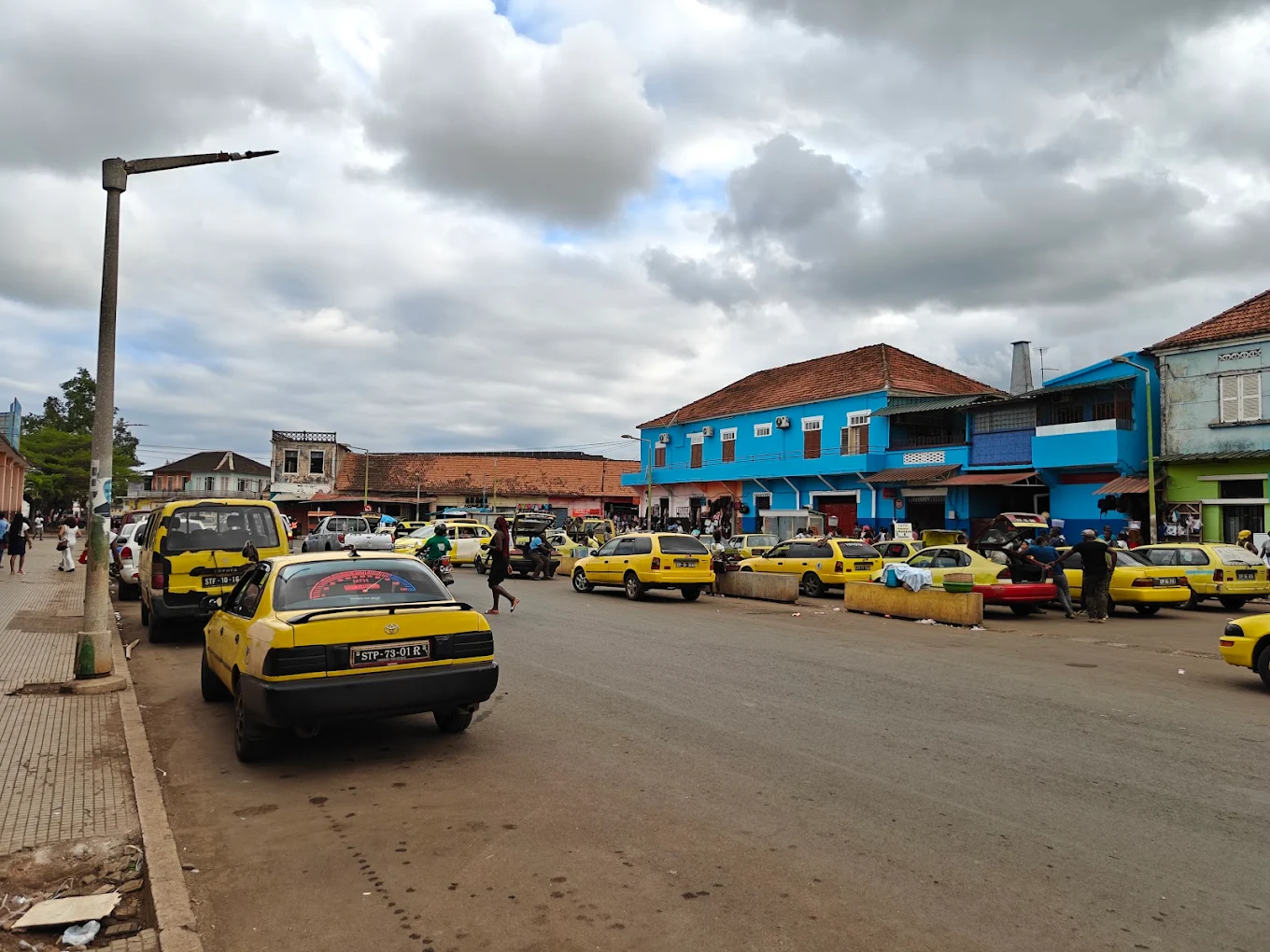
Travel Guide
Getting Around São Tomé and Príncipe
Taxis, Hiaces, moto-taxis, car hire and flights to Príncipe — how people actually move around the islands.
Getting around São Tomé and Príncipe is part of the rhythm of travelling here. People move around both islands every day without owning or hiring a car, using yellow Hiace minibuses, taxis, motorbikes and informal lifts.
What you will not find is a dependable network of timetables, marked stops and transport apps. Routes are understood locally, vehicles leave when they are ready and the simplest way to find the right one is often to ask somebody nearby.
Can you visit São Tomé without a car?
Yes. If you are staying in the city, travelling between the main towns or happy to combine different forms of transport, a car is not essential.
Hiaces travel from São Tomé city to all the major towns. Moto-taxis cover short local journeys but will also take you considerably further. Taxis and private drivers are available when you want a direct journey, while organised tours remove the need to work out each connection yourself.
The limitation is the final part of the journey. Beaches, roças, waterfalls and viewpoints are not necessarily beside a Hiace route. Places such as São Nicolau waterfall, Lagoa Amélia and more isolated beaches are awkward by shared transport alone. Without a car, use a Hiace for the main journey and arrange a motorbike, taxi or guide for the last stretch.
Hiaces: São Tomé's shared minibuses
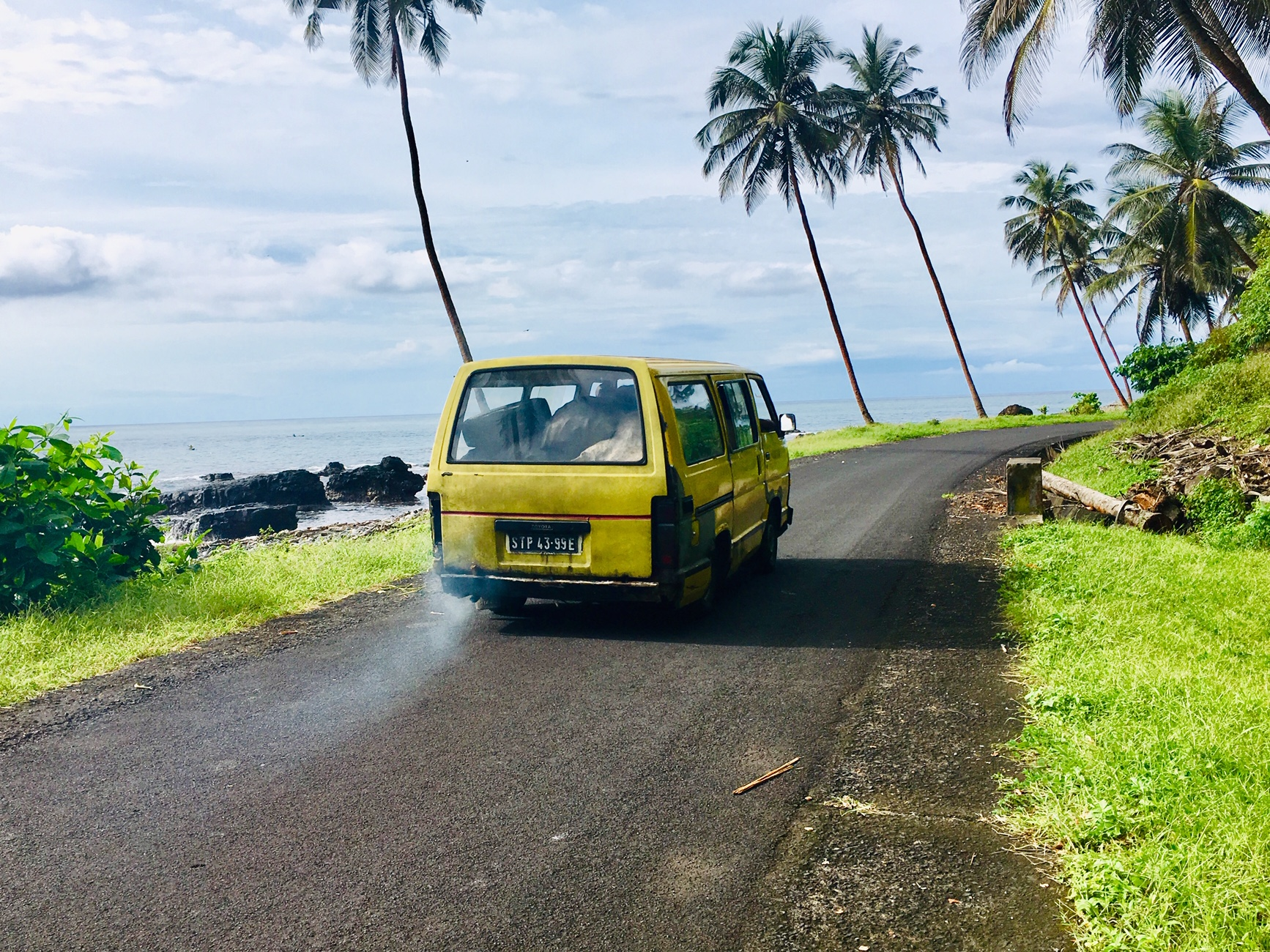
Hiaces are yellow minibuses connecting São Tomé city with the island's major towns. In the capital, they gather outside Continental supermarket. There is no useful route board: say where you are going and somebody will point you towards the correct vehicle. You can also flag one down on the road.
There is no timetable. A Hiace leaves when it is full, and full can mean very full. Drivers fit in as many passengers as possible; on a crowded journey, somebody may end up partly on your lap.
The driving can feel like a rally stage. It is often fun, but it is not a calm or spacious way to travel. If fast driving, close seating or a lack of personal space bothers you, use a taxi or private driver instead.
As a rough guide, a short journey may cost around 20 dobras, with longer trips commonly falling somewhere around 50 to 100 dobras. Ask the price before setting off and carry small notes.
Hiaces run throughout the day and into the early evening, but there is no dependable final departure. If you need to return to the city, start back while there are still plenty of people travelling rather than leaving it until after dark.
Moto-taxis
Moto-taxis are common, inexpensive and easy to flag down. They are useful for short journeys around the city, but riders will also travel between towns or cover the final stretch from a Hiace stop to a beach, roça or other attraction.
Agree the price before getting on. A short journey around town is normally around 20 dobras. For anything longer, ask rather than assuming the city fare still applies.
The helmet normally belongs to the driver; passengers should not expect to be offered one. Bring your own if that concerns you, or use a car. A motorbike can work with a small bag but is not a sensible airport transfer with a large suitcase.
Taxis and private drivers
Taxis congregate in central São Tomé and can also be flagged down or arranged through accommodation. They do not use meters or standardised pricing, so agree the destination and fare before getting in.
A taxi from São Tomé airport into the city is roughly 150 dobras. Hotel and out-of-town journeys cost more, and drivers may quote visitors in euros. Ask for the price in dobras and carry cash.
For a full day visiting beaches, waterfalls and roças, hiring a driver is simpler than arranging several separate taxis. It costs more than Hiaces and motorbikes, but gives you a direct route, space for bags and somebody who knows the roads.
There are no ride-hailing apps in São Tomé and Príncipe. Uber and similar services do not operate here.
Driving in São Tomé
Driving gives you more freedom, especially if you want to visit beaches, waterfalls and places outside the city. It also means adapting to local road habits.
Roads vary considerably. Some routes are straightforward, while others are rough, slow or affected by rain. Drive carefully, leave space and allow more time than the distance suggests. Traffic drives on the right, and street lighting outside the city is limited.
One local habit visitors may notice is that people sometimes place bags, clothes or other belongings in the road to make a driver stop. They may then jump in and ask for a lift. This can look strange if you are not used to it, but it is usually harmless. You may simply be helping somebody get to school, work or another part of the island.
Car hire and 4x4s
A hired car is useful if you want independence. It is especially helpful if you want to explore beyond the city, stop at beaches, visit several roças or move at your own pace.
A 4x4 is not about looking adventurous. It is about road conditions, rain, hills, tracks and comfort. Some journeys are considerably easier in a stronger vehicle, especially outside the better roads or after bad weather. Our guide to whether you need a 4x4 in São Tomé explains where a normal car is sufficient and where it is not.
If you are not confident driving locally, a driver may be a better option than hiring a car yourself. You still have the freedom to stop without the stress of navigation, poor surfaces and unfamiliar road habits.
Electric bike hire
Electric bikes offer a more relaxed way to explore the city and some coastal roads. They are not a substitute for a suitable vehicle on rough tracks, steep interior roads or long journeys into the south.
Walking
Central São Tomé is compact enough to explore on foot. Poor pavements, potholes and limited street lighting are more immediate problems than distance, so watch where you are walking and carry a torch after dark.
Walking is not a realistic way to link most attractions outside the city. Roads rarely have proper pavements or shoulders, and pedestrians share them with cars, motorbikes and animals.
Hitchhiking and informal lifts
Hitchhiking is a normal part of island life in São Tomé and Príncipe. Locals regularly ride in the back of pickup trucks, flag down passing vehicles or hop onto motorbikes heading in the right direction.
To stop a vehicle, give a clear wave. Simply standing beside the road will not make somebody assume you want a lift.
Motorbike riders and pickup drivers will often stop. If you are visibly a visitor, expect to contribute something towards the journey. A local may receive a free lift as a favour, but a visitor should not assume the same.
Check the small print of your travel insurance before relying on informal transport. Cover for accidents in unregistered vehicles varies.
Getting to Príncipe
There is no ferry service between São Tomé and Príncipe. Domestic flights are the normal way to travel between the islands.
Two airlines currently operate the route. STP Airways flies daily except Tuesdays, with two return flights on most days and a single flight on Saturdays. Afrijet flies on Thursdays and Sundays and also connects Príncipe with Libreville. There are no flights to Príncipe on Tuesdays.
Both airlines use small aircraft and luggage allowances are limited, particularly during high season. Pack light and check the allowance when booking. Rough weather can delay a flight, cause a cancellation or force an aircraft to turn back.
Check availability before fixing your travel dates. If you have an onward international flight or another commitment that cannot move, leave some margin around the Príncipe portion of the trip.
Getting around Príncipe
Príncipe is smaller and quieter than São Tomé, but transport is more expensive and less readily available. Visitors normally use taxis, accommodation transfers or a hired vehicle.
Rental cars are available, although they are expensive and can be rough. Do not assume a high daily price means a new or polished vehicle. Arrange airport collection and important journeys through your accommodation or a trusted contact rather than arriving and expecting a choice of cars.
Airport transfers
São Tomé airport is close to the city centre. A taxi into town is roughly 150 dobras, although a transfer arranged by a hotel may cost more. Confirm the fare before travelling.
Arrange collection in advance if you are arriving late, carrying substantial luggage or staying outside the city. A moto-taxi may cost less, but passengers are unlikely to be offered a helmet and a large suitcase makes it impractical.
Practical transport advice
You do not need a car to visit São Tomé. Hiaces reach the major towns, motorbikes fill the gaps and taxis or drivers cover journeys where shared transport becomes inconvenient.
Choose a car if independence matters more than cost or your plans include several remote places. Choose local transport if you have time, light luggage and do not mind sharing the journey very closely with everybody else.
Whichever option you use, carry small notes, agree taxi and moto prices before travelling, and begin return journeys before transport starts thinning out in the early evening.
Quick Facts
All Travel Guides
Ready to book?
Browse tours, hire a car, or ask us to help plan your itinerary.