Travel Guide
São Tomé 7-Day Itinerary
A realistic one-week route through the island, written by a resident.
This São Tomé 7-day itinerary gives a clear, realistic route through the island without pretending you can see everything in a week. São Tomé may look small on the map, but you could easily spend a month exploring every bay, roça and forest track. What follows is a highlight route that covers the capital, the northern cacao coast, the central highlands, the southern road and the west coast, with enough time to breathe. It suits independent travellers using car hire as well as those who prefer a driver, and is shaped by local experience rather than brochure copy.
Days 1 and 2: São Tomé City
Most European flights land in the late afternoon, so the first day of this itinerary is about arriving, reaching the city and finding your feet. An airport pick up into São Tomé City usually costs around fifteen euros, or we can arrange car hire directly from the airport if you prefer to start driving immediately. The drive into town is short, but traffic around the centre can be slow at busy times.
After checking in, the central area of São Tomé City is straightforward to walk. The Presidential Palace, São Tomé Cathedral and the I Love São Tomé and Príncipe sign are all within a compact area and are easy first landmarks to visit in the early evening. Street lighting is variable, so it makes sense to keep your first walk simple until you have a feel for the layout.
Older guidebooks still mention the Mercado Municipal as if it were active, but it has been closed for a long time. Only a few informal stalls operate behind the taxi rank. They are interesting to see as part of everyday life, but visitors should avoid seafood or meat from these stalls because storage and temperature control are poor.
For dinner, there are a handful of straightforward options in the city. Sum Secreta is open, despite what some online maps show, and offers a steady, no-nonsense evening meal. Many travellers are tired after the flight and choose to eat at their accommodation instead. We can help with basic settling tasks such as showing you the main streets, explaining where to find ATMs, or helping you buy a local SIM card so that the rest of your week in São Tomé is easier to manage.
Day 3: Cascades, Coffee and the Interior
Day 3 takes you away from the coast and into the cooler, forested highlands in the centre of the island. You check out of your accommodation in São Tomé City in the morning, as you will spend the night further south. This shift inland marks the middle section of the itinerary, where the scenery changes from coastline to rainforest.
The first stop heading south east is Roça Monte Café. Guided visits include a small museum and an explanation of how coffee is grown and processed on the estate. There are English speaking guides, although the tours themselves can feel quite flat, so we strongly suggest reading our roça guide before you visit to fill in the historical and social context most guests do not hear on site. At the end of the visit you taste a single type of coffee: either robusta or arabica.
Continuing further inland, you reach Cascata São Nicolau, a tall, narrow waterfall surrounded by dense vegetation. This stretch of road is unmade in places, with steep drops at the side, and children sometimes run down from the rainforest to sell the fruit they have gathered. Their enthusiasm regularly outweighs their sense of road safety, so it is important to drive slowly and keep your attention on the track. The falls are visible from the bridge near the road, but there is also a path that leads down towards the base. This path uses wooden steps that can be very slippery with algae because of the constant moisture. Move carefully and wear shoes with decent grip.
The day ends by heading down towards the eastern coast and the village of São João dos Angolares. Many travellers choose Roça São João dos Angolares as their base for the night. The main house and grounds have been restored as a rural guesthouse and restaurant that serves fixed tasting menus based on local ingredients. Advance booking is important in busier periods.
Day 4: Southern São Tomé and Pico Cão Grande
Day 4 focuses on the southern coast, starting from São João dos Angolares and following the main road towards Porto Alegre. Allow most of the day for this circuit. Distances are not large, but the road is narrow in places, you will stop often for views, and average speeds are low.
The road south passes through forested terrain and small communities before opening into views of the interior. As you continue, you begin to see Pico Cão Grande, the tall volcanic plug that rises sharply out of the rainforest. The peak appears and disappears with cloud cover and roadside vegetation, so most travellers pause at more than one informal viewing point rather than relying on a single fixed stop.
South of this area are several beaches with calmer sections when conditions are right, including parts of Praia Piscina. These coves can be suitable for swimming in settled weather, although tides, currents and swell change from day to day, and there is no lifeguard cover. Near Praia Inhame and Praia Jalé there are recognised turtle nesting areas during the appropriate season, but sightings depend entirely on timing and cannot be guaranteed.
Road quality on this southern stretch is mixed. Some sections are paved but worn, with potholes and broken edges, while other parts may be rougher after heavy rain. A vehicle with reasonable clearance is strongly recommended, and night driving on this route is best avoided. Fuel is more reliably available in and around São Tomé City than in the far south, so start with a near-full tank rather than relying on petrol near Porto Alegre.
Day 5: The Equator and the Coastal Return
Day 5 centres on visiting the Equator from the southern tip of the island. Travellers staying in the Porto Alegre area begin the day with a short boat transfer to Ilhéu das Rolas, which typically takes around fifteen to twenty minutes. The crossing is done in small local boats, and departures depend entirely on sea conditions. In rough weather crossings may be delayed or cancelled, so check locally before setting off.
When arranging the boat, do not commit to the first person you meet as you arrive. Wander into the village and ask around. The going rate for a full day is about 1,000 to 1,500 dobras, but visitors are sometimes quoted 3,000 to 4,000, so negotiate.
As you reach the village there is a stall on the right selling water and a few souvenir stands. The restaurant opposite is good, but the staff have taken leve leve to a new art form, so do not be in a rush. People from the village will offer to guide you to the Marco do Equador at the top. It is unnecessary as there are only a few paths and they all go uphill. If you do want a guide, agree around ten euros and do not pay more.
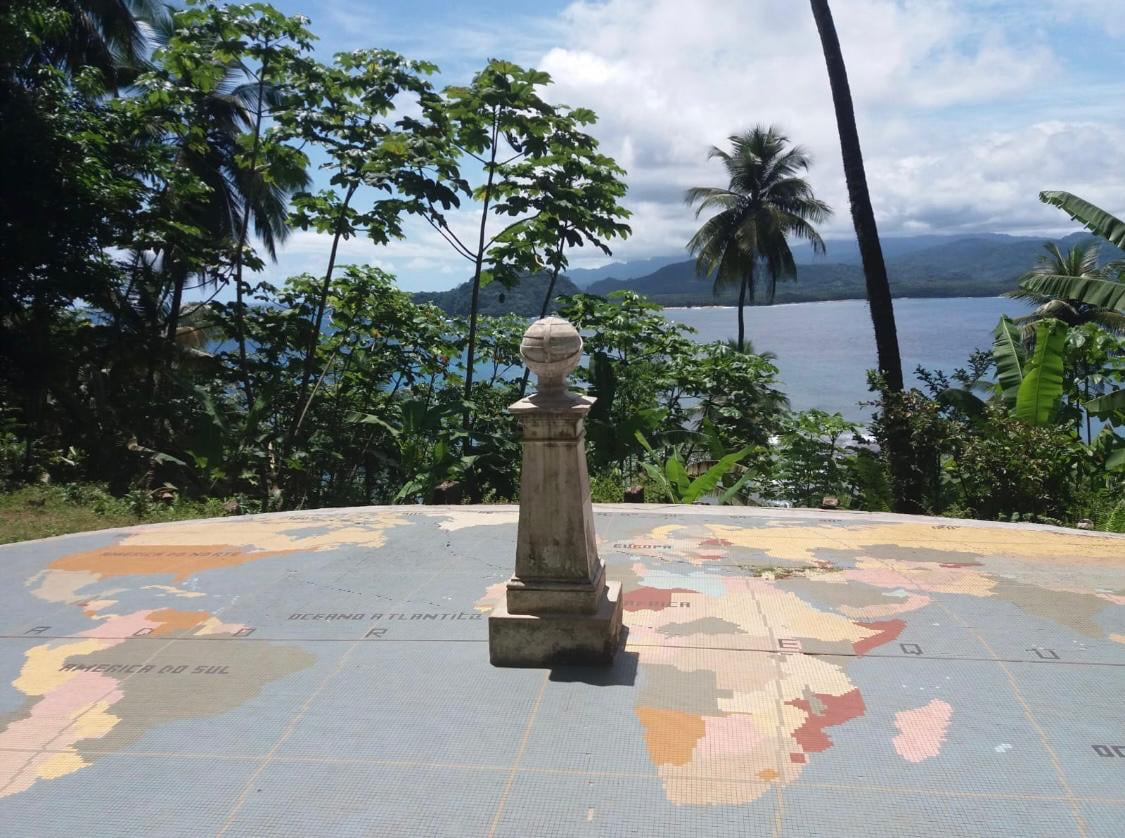
The monument stands on a hill with a clear viewpoint, while the exact geographic line crosses the small village below. Some visitors also walk to the lighthouse, Farol das Rolas, which gives wider views of the surrounding sea when access is safe and weather allows. The islet has several small beaches such as Praia Café and Praia Bateria, with sections of calmer water in settled conditions. Swimming and snorkelling depend entirely on tides and swell, and there is no lifeguard cover.
The afternoon boat returns to Porto Alegre. Once back on São Tomé, the route shifts north. Some travellers return directly to the city, while others stop around the Santana area to break up the journey.
Day 6: Botanical Garden, Interior Plantations and the West Coast
Day 6 links the interior highlands with the central west coast. You can either check into your final accommodation in São Tomé City in the morning, or stay in your current base around Santana and complete the loop before returning to the capital later in the day.
Begin by driving into the highlands towards Bom Sucesso Botanical Garden, near the entrance to Obô National Park. The garden sits at higher altitude, so the air is cooler and often misty. It focuses on endemic plants, including orchids and other species you will not see in the same way on the coast. Paths can be damp and uneven, so closed shoes are advisable, and showers often move in quickly.
From Bom Sucesso, continue to Roça Boa Entrada. This former plantation offers a different view of colonial history compared with the better-known coastal roças. Much of the infrastructure is now in poor condition, and the site feels lived in rather than restored, with local communities still using parts of the old estate. It is a useful stop if you want to see how plantation buildings have been adapted over time rather than turned into a polished attraction.
Later in the day, drive the central west coast road towards villages such as Santa Catarina. This stretch is known for its rugged scenery and views out to sea, and the road surface is variable, with sections that can be affected by erosion or minor landslides after heavy rain. There is a short tunnel cut through the rock that many visitors use as a photo stop.
Children often gather at the tunnel and along sections of the west coast road. They may call out asking for sweets, and some carry small machetes used for cutting fruit they collect from the surrounding forest. These are working tools rather than weapons, but the combination of enthusiasm and a busy roadside means you should take care when pulling over. It is best not to give sweets during school hours. After completing this circuit, return to São Tomé City for your final night.
Day 7: Farewell São Tomé
Day 7 depends on your departure time. Many international flights leave later in the day, which often allows a quiet final morning in or around São Tomé City. This last day is not about racing to new sights, but about closing the week in a calm and practical way.
If you have a few free hours, stay close to the city. One option is to walk through the centre and visit a couple of small shops for sealed coffee, chocolate or simple wooden souvenirs. Another option, when weather and sea conditions are stable, is a short visit to an accessible nearby beach such as Praia Muanda for a final walk along the sand.
Most visitors either request a late checkout or leave luggage at their accommodation before heading out for these last errands. Plan enough time to collect your bags and drive back to the airport without rushing. Under normal conditions the transfer from São Tomé City to the airport is short, but it is still sensible to arrive several hours before your flight.
Related Guides
All Travel Guides
Ready to book?
Browse tours, hire a car, or ask us to help plan your itinerary.