Travel Guide
São Tomé and Príncipe 14-Day Itinerary
A fourteen-day slow travel route across both islands, written by a resident.
This 14-day itinerary is designed for slow travel, leve leve, avoiding rushing and outdated guidebooks. São Tomé provides the capital, the central highlands, and the dramatic southern coastline, while Príncipe offers quieter villages, jungle trails, volcanic viewpoints, and calmer beaches. The two-week route balances roça visits, time in the rainforest, light coastal exploration, and simple beach days. Built from local experience, this guide reflects the current travel pace, on-the-ground conditions, and practical challenges you will actually encounter over fourteen days.
Day 1: Arrival, Settling In, City Landmarks
Day 1 begins gently, as most European flights land in the late afternoon, so there is no pressure to do more than settle in. An airport pick up into São Tomé City usually costs around fifteen euros, or we can arrange car hire directly from the airport if you prefer to start driving immediately. The drive into town is short, but traffic around the centre can be slow at busy times.
After checking in, the central area of São Tomé City is straightforward to walk. The Presidential Palace, São Tomé Cathedral and the I Love São Tomé and Príncipe sign are all within a compact area and are easy first landmarks to visit in the early evening. Street lighting is variable, so it makes sense to keep your first walk simple until you have a feel for the layout.
Older guidebooks still mention the Mercado Municipal as if it were active, but it has been closed for a long time. Only a few informal stalls operate behind the taxi rank. They are interesting to see as part of everyday life, but visitors should avoid seafood or meat from these stalls because storage and temperature control are poor.
For dinner, there are a handful of straightforward options in the city. Sum Secreta is open, despite what some online maps show, and offers a steady, no-nonsense evening meal. Many travellers are tired after the flight and choose to eat at their accommodation instead. We can help with basic settling tasks such as showing you the main streets, explaining where to find ATMs, or helping you buy a local SIM card.
Day 2: Roça Monte Café and Cascata São Nicolau
Day 2 takes you inland to the central highlands, an area where the temperature drops, the vegetation thickens, and the first sense of the island's interior opens up. Rather than rushing through, this day is paced for travellers who want to understand how the coffee belt shaped São Tomé, both historically and socially.
Your first destination is Roça Monte Café. Sitting at altitude above the coastal humidity, the plantation feels noticeably cooler and quieter than the city. The guided visit takes you through the small museum and the old processing buildings, with an outline of how coffee cultivation developed here. The guides are English speaking, although the tours can be fairly minimal, so having background knowledge helps you join the dots that are not always covered on site. Tastings involve choosing between a robusta or an arabica brew. Bring a light layer or a jacket as the altitude means the air is cooler and often misty, especially in the morning.
Further inland, the road leads to Cascata São Nicolau. This tall waterfall drops through a narrow gap in the forest and is visible from the bridge, but a short path leads down to the base for those who want a closer view. The steps are wooden, shaded, and frequently damp, and the rainforest has begun to reclaim parts of the route. The drive here requires extreme attention. The track is unmade in long stretches, with steep edges and occasional clusters of children selling fruit who run quickly towards passing cars. Slow, careful driving is absolutely essential.
By late afternoon you return to São Tomé City rather than moving accommodation. This keeps the opening stages simple and allows you to begin the northern loop the following morning without changing bases.
Day 3: Northern Coast Loop and Lagoa Azul
Day 3 focuses on the northern coast, a straightforward loop that combines older plantation buildings with volcanic bays and simple coastal scenery. You begin in São Tomé City and follow the main coastal road north. The route is simple to navigate and avoids complicated junctions, which keeps the morning easy.
A practical first stop is the Diogo Vaz outlet in the city. It is the most reliable place to buy their chocolate or coffee products without depending on opening hours at roças further along the route. After leaving the city, the road passes small villages and pockets of coastline before rising gently inland toward Roça Agostinho Neto. This was once the largest plantation complex on the island. The main avenues and large stone buildings show the scale of historic plantation agriculture, and the site has a mix of restored areas and older sections that continue to age naturally.
From Agostinho Neto the road leads back toward the sea and eventually reaches Lagoa Azul. This sheltered bay is known for volcanic rock formations and calm pockets of water on stable days. Swimming and light snorkelling are possible when conditions are safe, but there is no supervision and visitors must judge the sea on the day.
The loop can be completed in half a day or extended depending on how long you spend at each stop. You finish the day back in São Tomé City before your transfer to Príncipe on Day 4.
Day 4: São Tomé to Príncipe Transfer
Day 4 is the transfer from São Tomé to Príncipe. Flights usually operate once on the days they run and use small aircraft with limited seating and strict luggage limits. Weather on both islands can affect visibility and wind conditions, so departures are sometimes delayed and your accommodation will confirm the final schedule on the day. Arrive at the airport early, keep baggage within the stated weight limits, and be ready for possible adjustments.
The flight takes roughly forty minutes. On arrival at Príncipe Airport, you are met by your accommodation or a pre-arranged transfer. Independent exploration on Príncipe is limited because the island has few roads and most inland areas require local knowledge. Transport and activities are normally organised through lodges or local operators rather than attempted alone.
After checking in, most visitors spend the afternoon settling into the quieter rhythm of the island. Santo António is the smallest capital city in Africa and offers a short riverside walk and a simple introduction to local life if you have the energy. Evening meals are generally taken at your accommodation, as dining options elsewhere are limited and roads are not ideal after dark on an unfamiliar island.
Day 5: Oquê Pipi Waterfall Trail from Porto Real
Day 5 focuses on the guided hike to Oquê Pipi Waterfall, one of the most established walking routes on Príncipe. The walk begins near Porto Real, which most visitors reach by car or taxi from Santo António or nearby lodges. The island is compact, so the drive usually takes between fifteen and thirty minutes depending on your starting point.
There is no paved road to the waterfall. All access continues on foot, and most travellers arrange the hike through their accommodation or a local operator. The trail passes through protected forest and conditions change quickly after rain. Guides decide on the day whether the route is safe to walk. The path includes shaded slopes, exposed roots and small stream crossings, so basic fitness and sturdy shoes are important.
The walk normally takes one and a half to two hours in each direction. At the end of the trail you reach a tall, narrow waterfall and a natural pool where swimming may be possible when the water is calm. After heavy rain the pool can become cloudy or more forceful, and your guide will advise whether entering the water is sensible. Bring drinking water, insect repellent and a swimsuit.
The return follows the same route. With transfers, time at the waterfall and the walk itself, this usually fills most of the day. Most visitors eat dinner at their lodge because options elsewhere are limited.
Day 6: Flexible Exploration Day on Príncipe
Day 6 focuses on Príncipe's coastline. The exact plan depends on sea conditions and what your accommodation can arrange, but a common structure is a half-day boat trip combined with time on the beach and an option for simple local fishing.
Most lodges can organise a small boat outing along the forested coast, taking in views of cliffs, inlets and offshore rocks. When the sea is calm there are usually chances to stop in sheltered bays for swimming or light snorkelling. In settled weather, some trips also include a visit towards Baía das Agulhas to see the tall rock towers that rise out of the water, which are among Príncipe's most recognisable landmarks.
If you are interested in fishing, you can often arrange something straightforward with local fishermen through your accommodation. These are small-scale trips that use simple gear and follow local practice rather than intensive sport fishing.
The rest of the day is flexible. Some people stay by the beach, others return earlier to their lodge to read, swim in the pool or walk to a nearby viewpoint. Most travellers eat dinner at their accommodation.
Day 7: Return to São Tomé
Day 7 is the return flight from Príncipe to São Tomé. As with the outward journey, be at the airport early and keep luggage within the stated limits. Delays due to weather or scheduling are possible, so do not plan anything time-critical on this day.
After landing back in São Tomé, most travellers head to accommodation in the south of the island or near the interior, positioning themselves for the Bom Sucesso and Lagoa Amélia area on Day 8. If you prefer to rest in the capital first, that is equally practical, though it adds some driving the following morning.
The afternoon can be used to restock supplies, confirm plans for the southern days ahead, and rest after the travel.
Day 8: Lagoa Amélia and Bom Sucesso
Day 8 is your first full day back on São Tomé after returning from Príncipe. The focus is the interior around Bom Sucesso and the Lagoa Amélia trail, which gives a clear sense of the rainforest that dominates the central highlands.
In the morning you drive up into the hills to the Bom Sucesso area, where the air is cooler and mist is common. From here, a guided walk leads into the forest towards the crater rim of Lagoa Amélia. The route is usually described as moderate, but the ground can be muddy, with roots, rocks and sections that become slippery after rain, so decent footwear is important. Local guides know the path and set the pace, and walking sticks are often used on the steeper or wetter sections.
The full outing typically occupies several hours once the drive, the walk and pauses for rest are included. Travellers who do not want the longer hike can stay closer to Bom Sucesso and visit the nearby botanical garden instead, which shows many of the island's plant species on short, easier paths.
By mid or late afternoon you return to your accommodation. The rest of the day is usually quiet, with time to shower, rest and eat at your lodge before heading south the following morning.
Day 9: Southern Road and Pico Cão Grande
Day 9 continues south from your base near the interior. The plan is simple: follow the main EN-2 road towards the southern coast and spend the day around the viewpoints and small communities between the highlands and Porto Alegre.
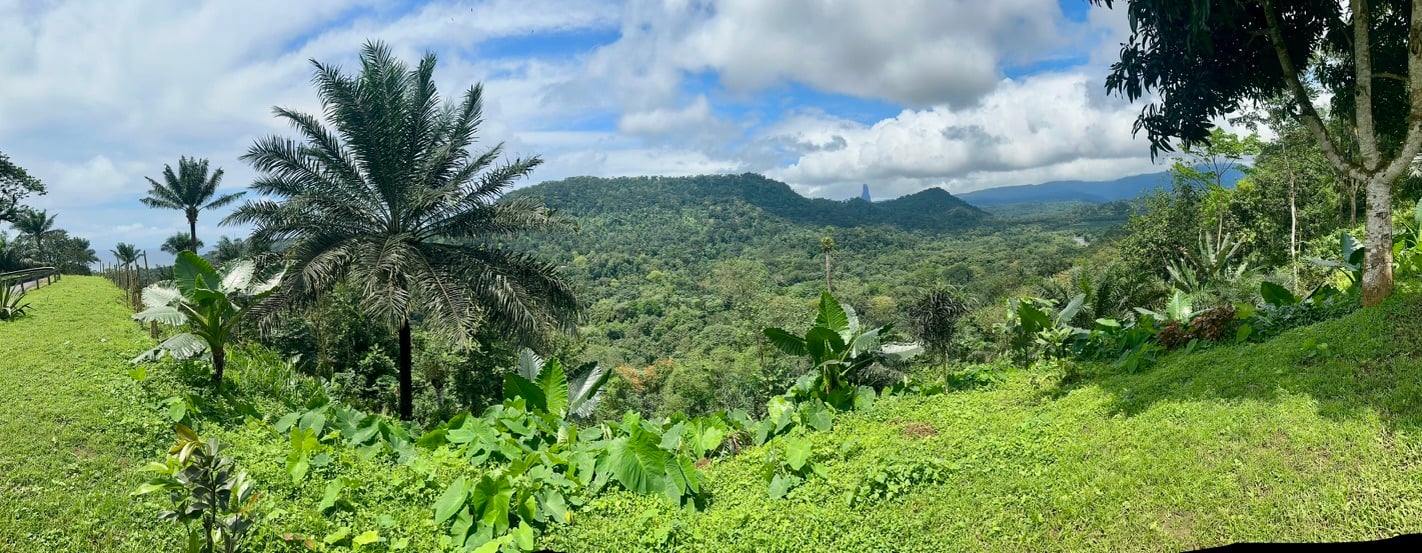
The road gradually descends through forest and farmland before opening into the southern landscape. As you continue, you gain your first clear views of Pico Cão Grande, the volcanic tower that rises sharply out of the rainforest. Cloud cover changes quickly in this area, so most travellers stop at several informal pull-offs rather than relying on a single viewpoint. Visibility depends entirely on the weather on the day.
The southern road varies in condition. Some sections are paved but worn, others are rough with potholes or broken edges, and recent rain increases the chance of mud or standing water. A vehicle with reasonable clearance makes the drive more comfortable, and travelling in daylight avoids unnecessary risk.
The value of the day comes from the drive itself, the changing scenery and the gradual transition from the interior to the southern settlements. Most travellers end the day in accommodation on the south-eastern side of the island or near Porto Alegre.
Day 10: Coastal South and the Approach to Porto Alegre
Day 10 continues along the southern end of the island, linking the inland landscape to the coast. The EN-2 road moves through small communities before reaching the lower, more humid stretches near São João dos Angolares and further south.
As you travel, the scenery shifts from dense vegetation to open coastal views. This section of the island is known for its contrasting terrain, with steep forested hills on one side and exposed volcanic coastline on the other. Conditions vary by weather, and low cloud can move quickly across the interior ridges.
Continuing south brings you into the main stretch where travellers normally stop for views, short walks or coastal photographs. Road conditions are mixed, especially after rainfall, and drivers take their time on this section. Reaching Porto Alegre gives access to the small community at the island's southern tip, which serves as a base for visiting Ilhéu das Rolas the following day.
The rest of the afternoon is usually spent settling into accommodation around Porto Alegre or São João dos Angolares. Keep the evening simple and rest before the Equator crossing on Day 12.
Day 11: Roça Água-Izé and the Southern Coast
Day 11 begins with Roça Água-Izé, one of the most important plantation sites in São Tomé's cocoa history. The complex is large, and although parts of it are heavily weathered, the size of the central avenue, the layout of the estate and the remains of the hospital show how significant this roça once was. Take time to walk the grounds as much of the impact comes from the scale and atmosphere rather than formal interpretation.
After leaving Água-Izé, continue south towards the beaches near Praia Jalé and Praia Inhame. These areas can feel remote and quiet, with stretches of coastline that change depending on tides and swell. During the right season, this is also one of the main regions associated with turtle nesting, though sightings depend entirely on timing and conditions.
The afternoon is usually spent moving slowly along this section of coast, stopping where road conditions allow and where the sea is calm enough for a short walk. Most travellers remain in accommodation in the south so that the following morning's plans do not require a long drive back from the city.
Day 12: Ilhéu das Rolas and the Equator Line
Day 12 focuses on visiting Ilhéu das Rolas and standing at the Equator, using Porto Alegre as your starting point. The boat transfer from Porto Alegre takes around fifteen to twenty minutes in small local boats. Departures depend entirely on sea conditions, so confirm locally before setting out. Do not commit to the first boatman you meet. Wander into the village and ask around. The going rate for a full day is about 1,000 to 1,500 dobras.
With two weeks rather than one, you can afford to spend a proper half day on the islet rather than rushing up to the monument and back. The village itself is worth walking through slowly. There is a restaurant opposite the landing point that serves good food, though the staff operate on island time, so order early if you are hungry.
The Marco do Equador sits on the hilltop with views in every direction. The walk up is straightforward and does not need a guide, despite what locals at the bottom will tell you. The lighthouse, Farol das Rolas, is worth the extra walk if conditions are clear.
If you have the afternoon free, the beaches on the islet are quieter than anything on the main island. Settled conditions allow swimming and light snorkelling, but there is no lifeguard presence and the sea changes daily. Your boat returns to Porto Alegre in the afternoon.
Day 13: Turtle Season or a Final Cultural Day
Day 13 gives you a flexible choice depending on when you travel. For visitors arriving during the nesting season, this is the point where you can arrange an evening turtle watch at Praia Jalé or nearby stretches of the southern coast. These outings are arranged locally, depend on the exact timing within the season, and require patience as sightings are never guaranteed. Local monitors handle the process and advise on how to approach the beach quietly and without lights.
If you are outside turtle season, Day 13 becomes a quieter cultural day. Many travellers use it to revisit a southern beach, walk locally around their accommodation, or gradually work north towards the city. Some prefer to spend the afternoon exploring parts of São Tomé City they did not see at the start of the trip, including smaller streets, viewpoints, or simple cafés.
Evenings are generally spent close to your accommodation, either in the south or nearer to the capital depending on where you plan to stay for your final night.
Day 14: Final Morning and Departure
The final day is kept simple so you can prepare for your journey home without pressure. Most international flights leave in the late afternoon or evening, giving you several quiet hours to rest, organise luggage, or take a last short walk around São Tomé City.
Some visitors spend the morning near the water if conditions are calm, while others stay within their accommodation, especially if a late checkout has been arranged. Plan to arrive at São Tomé International Airport early. Check-in and departure procedures can move slowly, especially when multiple flights overlap, so allow more than two hours. Pre-arranged transport is the most reliable option.
Before you leave, consider what you can spare. Half-used toiletries, a t-shirt, the snorkelling mask that will sit in a cupboard at home: these things have real value here. Leave them with us and we will make sure they reach the people who need them most. It costs you nothing but a little space in your bag on the way home.
Related Guides
All Travel Guides
Ready to book?
Browse tours, hire a car, or ask us to help plan your itinerary.