The Roças ofSão Tomé and Príncipe
Colonial plantation estates inscribed as UNESCO World Heritage Sites in 2026. Their history, architecture and living communities explained.
A roça is one of the most distinctive things in São Tomé and Príncipe. The word means little more than cleared land, a field cut from scrubland, but on these islands it grew into something far larger: a self-contained plantation city, built on cocoa and coffee, on forced labour, and on a system of control that shaped the islands' economy for over a century. In July 2026, UNESCO recognised six of these estates as World Heritage Sites, the first such inscription in the country's history. Understanding what a roça was, and what it still is, is essential context for any visit to the islands.
26 July 2026
A UNESCO World Heritage Site
On 26 July 2026, UNESCO's annual General Assembly, meeting in Busan, South Korea, voted to inscribe six roças of São Tomé and Príncipe on the World Heritage List. It was the country's first ever inscription.
The six recognised properties are Água Izé, Monte Café, Diogo Vaz and São João dos Angolares on the island of São Tomé, and Sundy and Belo Monte on the island of Príncipe. The nomination, drafted by heritage organisation CRAterre in collaboration with local stakeholders and the Ministry of Education, Culture and Science, documented over 330,000 people whose names appear in historical records as having been brought to the islands, by force or coercion, to work the estates. The designation also acknowledges the living agroforestry landscape that now combines cocoa and coffee trees with large-canopy forest species, producing some of the world's most sought-after organic harvests.
São Tomé and Príncipe also holds the distinction of being the first country in the world in which the entire national territory was designated a UNESCO Biosphere Reserve.
Definition
What is a Roça?
The word roça comes from the Portuguese verb roçar, to clear scrubland. In the early years of the islands' settlement, it simply described a small field cut from the forest for subsistence crops. By the late nineteenth century the meaning had shifted entirely. On São Tomé and Príncipe, a roça had become a vast, industrialised plantation estate, closer in scale and organisation to a factory town than a farm.
At the height of the cocoa and coffee boom, the archipelago had more than 150 active roças. The largest employed several thousand people and covered thousands of hectares. They ran their own hospitals, schools, bakeries, mechanical workshops and narrow-gauge railway systems. A bell controlled the working day. Large gates at the main entrance restricted movement in and out. The community of workers at a major roça could outnumber the population of the nearby towns.
Layout and design
The Architecture of Control
Every roça followed a recognisable spatial logic, laid out to maximise production and reinforce hierarchy.
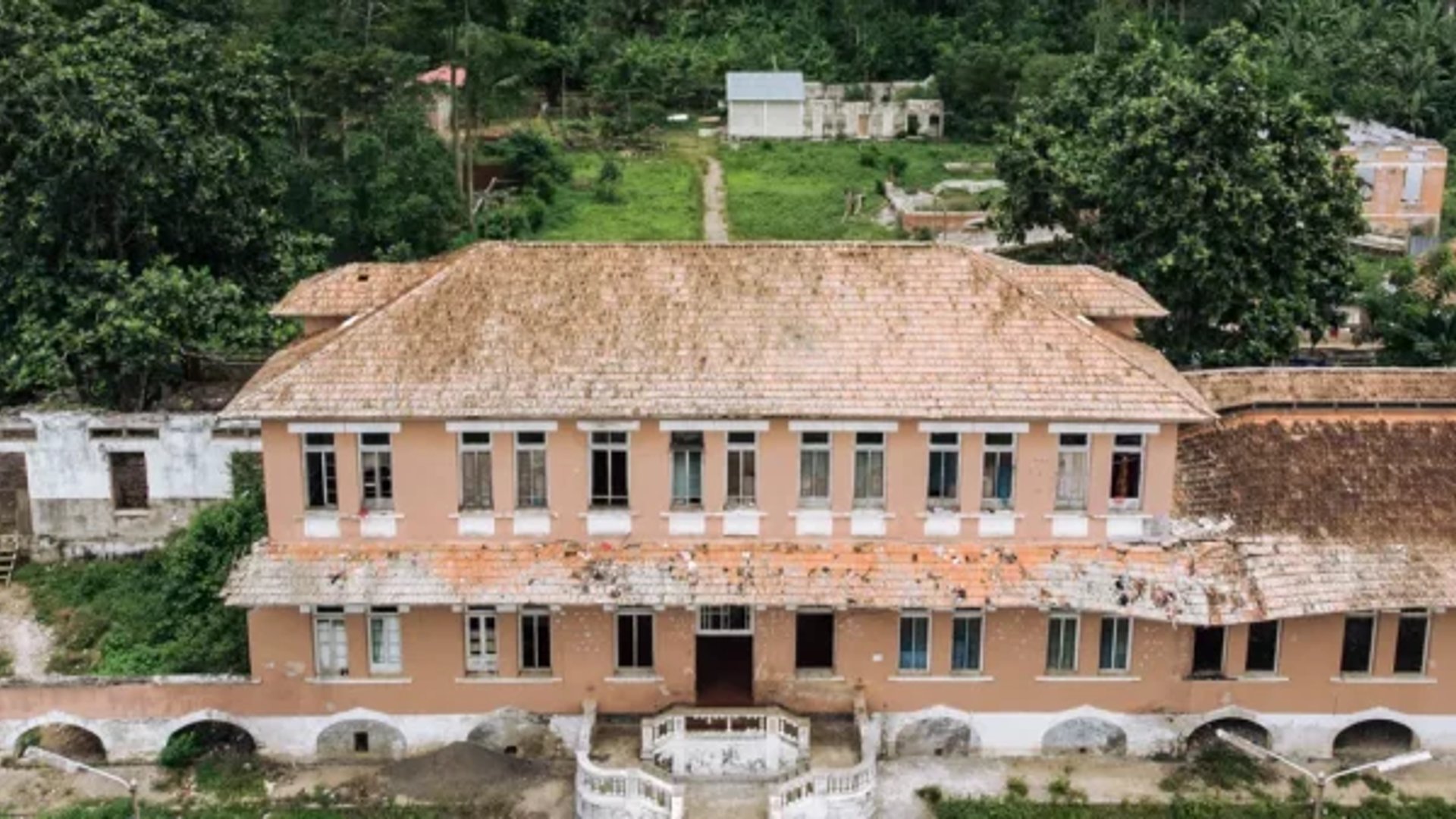
At the top of the estate stood the Casa Grande, the main house where the owner or administrator lived. Its position was deliberate: from the balcony, the administrator could survey the entire estate below. Below the Casa Grande came the operational heart of the roça: the terreiro (drying patio), fermentation tanks, washing channels, processing sheds and curing buildings. Where the terrain allowed, narrow-gauge railways moved harvested cacao and coffee down from the upper fields to the coast.
Set apart from the working buildings, physically separated to maintain social distance, were the senzalas: the communal quarters where the workforce lived. Women typically handled fermentation and drying; men worked the fields and transport. The layout reinforced the hierarchies of the colonial system in every direction.
The larger estates also included schools, chapels and infirmaries. These were practical tools for keeping a permanent, captive workforce on site rather than acts of generosity, though the infrastructure they left behind is real, and much of it still stands.
Economic history
Sugar, Cocoa and Coffee
The Portuguese settled São Tomé and Príncipe in the late fifteenth century, finding uninhabited volcanic islands with fertile soil and a year-round equatorial climate. Sugar was the first crop, and for two centuries São Tomé was one of the world's major producers. When the sugar trade moved to Brazil and the Caribbean, the islands declined in economic importance.
The second boom came in the nineteenth century. Cacao trees, grafted from Brazilian stock onto the volcanic soil of São Tomé, produced a bean of exceptional quality. By the 1880s, São Tomé and Príncipe had become the world's largest producer of cocoa, a position held into the early twentieth century. Coffee followed a similar arc. Estates like Monte Café, covering the highland slopes in the island's centre and north, became the backbone of a global trade.
At the height of this boom, the roças covered most of the islands' productive land and housed more people than the towns. The wealth generated left the islands almost entirely and flowed to Lisbon and to the shareholders of the great plantation companies.
Labour and legacy
The Serviçais and the Tongas
When slavery was formally abolished in the Portuguese empire in 1875, the roça system adapted rather than ended. The owners introduced a structure of contract work. The serviçais, as the contracted workers were known, were recruited, often by force or deception, from Angola, Mozambique, Cape Verde and neighbouring Gulf of Guinea islands. Contracts were routinely renewed without workers' consent. Wages were structured so that earnings returned to the roça's own stores. There was no realistic route back to the workers' home countries.
British journalist Henry Nevinson documented conditions on the islands in 1906. His reporting led Cadbury, at the time one of the world's largest buyers of São Tomé cocoa, to boycott the islands' produce in 1909. The international attention was significant, though conditions improved only slowly. The nomination documentation submitted to UNESCO counted over 330,000 named individuals who were uprooted from their homelands to work the estates across the full period of the system.
The descendants of those who remained in São Tomé after independence are known as Tongas, a distinct social group who still live on and around many of the former roças. They are part of the living reality of these places, not a historical footnote.
1975 to today
Independence and After
São Tomé and Príncipe became independent in 1975. The new government nationalised the roças almost immediately, folding them into a state agricultural structure. The timing was difficult: global cocoa and coffee prices fell in the same period, and competition from other producers intensified. Without the administrative infrastructure, and the coercive workforce control, of the colonial era, production collapsed.
Many roças were simply abandoned. The results are visible across the islands today: long avenues of worker housing returning to the forest, processing buildings with rusted machinery and collapsed roofs, great houses standing half-empty. It is an unusual landscape, the rainforest reclaiming, slowly but steadily, what the plantation once cleared.
Some roças survived through community occupation. From the 1990s onwards, others were leased to private operators and converted to hotels, eco-lodges or working farms. A handful returned to producing cocoa and coffee, some of it certified organic and sold internationally.
UNESCO Inscription 2026
The Six World Heritage Roças
The 2026 inscription covers six estates chosen for the quality and authenticity of their architecture. Each has a distinct character and history.
Largest inscribed estate
Água Izé
The largest and most architecturally dramatic of the inscribed roças, located on the southeast coast of São Tomé. Its name honours the Portuguese baron who introduced cocoa cultivation to the island in the nineteenth century. Long avenues of worker housing, vast cacao processing buildings and the scale of the ruins give the clearest sense of how the system operated at full capacity. Accessible from the main road between São Tomé city and the south.
Most visited
Monte Café
The highland coffee estate whose land extends from the centre to the north of São Tomé island. The most visited roça on the island, it includes a small museum with guided explanations of the coffee production process and continues to produce coffee today. English-speaking guides are available, though we recommend reading about the roça system before arriving to fill in the social and historical context that most on-site tours do not cover in depth.
Working organic estate
Diogo Vaz
Now producing certified organic chocolate, Diogo Vaz demonstrates one model for what a roça's future can look like: productive use of the land that does not erase the history of the buildings. The estate's chocolate is available in specialist organic markets internationally.
Southern circuit
São João dos Angolares
Located at the southern entrance to the town of Angolares, this roça is among the most accessible on the southern circuit. Angolares itself is historically significant: its population descends from enslaved Africans who escaped the plantations and founded free communities in the mountains.
Einstein's eclipse, 1919
Roça Sundy
Perhaps the most internationally significant location in the group. On 29 May 1919, British physicist Arthur Eddington observed a solar eclipse from the grounds of Roça Sundy and confirmed Einstein's General Theory of Relativity, one of the defining moments in the history of science. The estate is now home to Roça Sundy lodge, part of the HBD Príncipe Collection.
Above Praia Banana
Roça Belo Monte
Situated above one of Príncipe's finest beaches, Belo Monte is also a lodge within the HBD Príncipe Collection. The intact colonial architecture and forest setting make it one of the most atmospheric of the six inscribed properties.
Practical guidance
Visiting the Roças
The roças are not heritage sites in the museum sense. Most are inhabited communities, and a visit requires a degree of care. A small entrance fee is common at the more organised estates. Engaging a local guide is both a practical and respectful choice, and a direct contribution to the community that lives there.
For a structured experience, our guided heritage tours take in the main roças with local guides who have detailed knowledge of both the history and the communities. We plan visits to be low-impact and rooted in local knowledge rather than spectacle.
If you are staying at one of the roça hotels on São Tomé or Príncipe, you are already inside this history. The buildings around you, the landscape and the people nearby are all part of the same story.