Príncipe Hiking Guide
Oquê PipiWaterfall Trail
A rainforest walk to Príncipe’s largest waterfall and its cold natural swimming pool.
Oquê Pipi is the largest waterfall on Príncipe and one of the island’s most accessible rainforest walks. The trail climbs through Parque Natural do Príncipe before reaching a tall cascade and a cold natural pool where swimming is possible.
It is a good choice for visitors who want to experience the island’s protected forest without committing to a longer and more demanding mountain route.
The Waterfall
How Tall Is Oquê Pipi?
Príncipe Natural Park describes Oquê Pipi as approximately 30 metres high. Informal descriptions sometimes give higher figures, but there is no widely published technical survey establishing a different measurement.
From the base, the waterfall drops through a high wall of forest into a natural pool. Spray reaches the surrounding rocks and vegetation, particularly when the flow is strong.
Local Language
The Name
The name appears in several forms, including Oquê Pipi, O Quê Pipi and Oquêpipi. All refer to the same waterfall.
Oquê is locally understood as meaning mountain in Lunguyê, the traditional language of Príncipe.
On Foot
The Route
The journey south from Santo António passes through Príncipe’s former plantation landscape before reaching the start of the forest trail.
The path climbs steadily through closed forest. It is not technically difficult, but exposed roots, wet leaves and mud make the surface slippery after rain. One steeper section requires additional care.
The forest canopy closes overhead for much of the walk. Accredited guides identify medicinal plants, native species and birds along the route.
You hear the waterfall before reaching the final bend. The trail ends at the base of the cascade, where there is time to swim and rest before returning by the same route.
Deep Time
Geology and Landscape
Príncipe is the oldest of the oceanic volcanic islands in the Gulf of Guinea. The island formed approximately 31 million years ago as part of the Cameroon Volcanic Line.
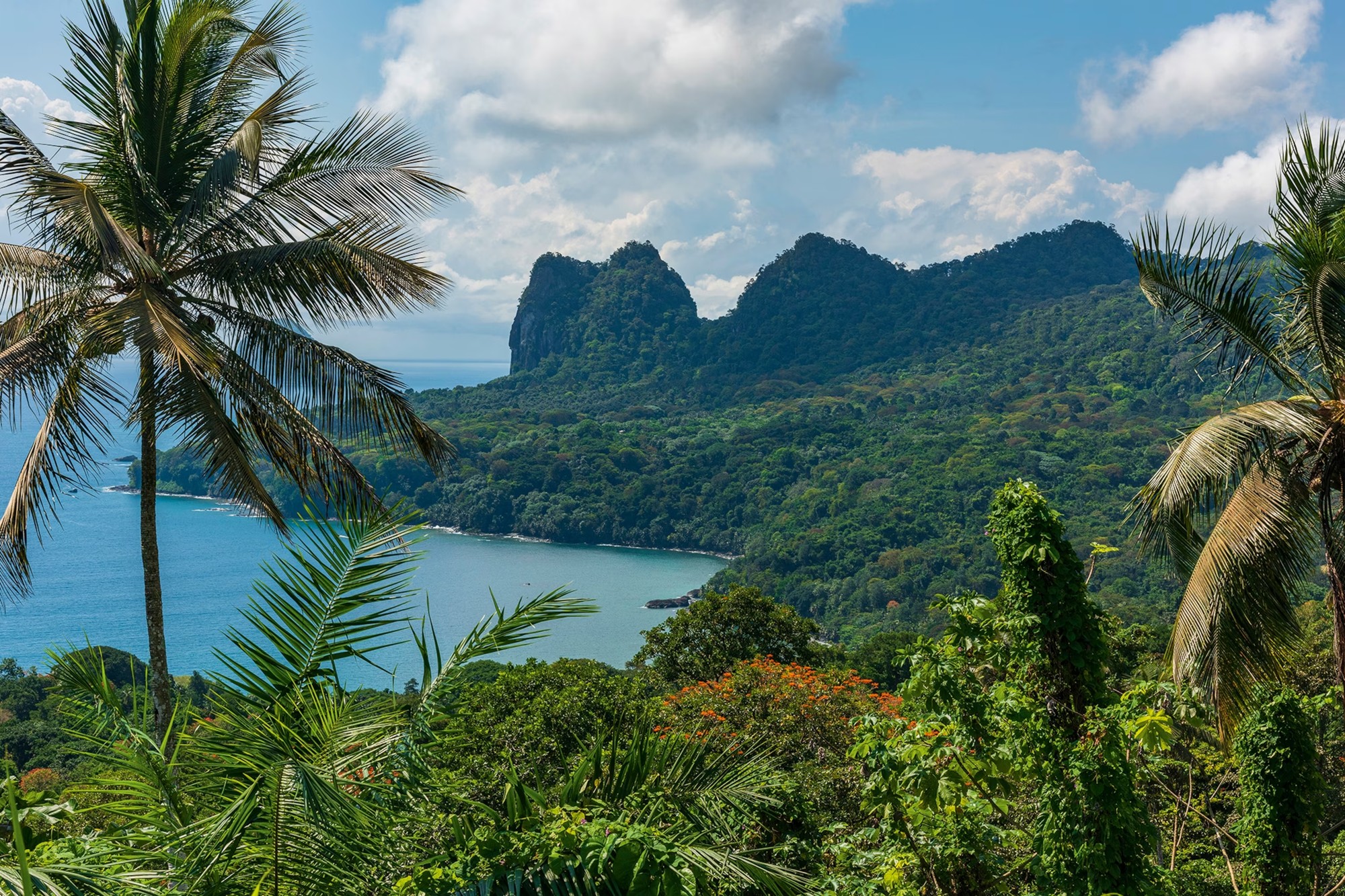
Millions of years of erosion shaped the original volcanic landscape into steep forested ridges, valleys and exposed phonolitic peaks. Pico do Príncipe, at approximately 948 metres, is the island’s highest point. Boné do Jóquei is one of its most recognisable volcanic formations.
Oquê Pipi is part of this deeply eroded landscape. Rain falling on the high ground feeds short rivers and streams that descend rapidly through the southern forest.
Key Information
Location
Southern Príncipe, inside Parque Natural do Príncipe.
Difficulty
Easy to moderate.
Walking Time
Approximately 1 hour each way.
Total Experience
Around 4 hours with transport and time at the waterfall.
Terrain
Forest path, roots, mud and one steeper section.
Guide
Accredited guide required.
Swimming
Natural pool at the base.
Season
Open throughout the year.
Best Conditions
June to September.
Conservation
The Protected Forest
The trail runs through Parque Natural do Príncipe, established in 2006 to protect approximately 8,500 hectares of forest, coastal and marine ecosystems.
Príncipe became a UNESCO Biosphere Reserve in 2012. The designation covers the entire island, its surrounding islets and a substantial marine area.
The island supports exceptional levels of endemism among its plants, birds, reptiles, molluscs and other wildlife.
Birdlife
Birds Along the Trail
Príncipe has numerous birds found nowhere else in the world. Species that may be encountered around the forest include:
- Dohrn's thrush-babbler (Horizorhinus dohrni)
- Príncipe kingfisher (Corythornis nais)
- Príncipe speirops (Zosterops leucophaeus)
- Príncipe starling (Lamprotornis ornatus)
- Príncipe sunbird (Anabathmis hartlaubii)
- Grey parrot (Psittacus erithacus)
Birds are often easier to hear than see beneath the dense canopy. A guide familiar with their calls gives you a much better chance of finding them.
The Príncipe scops owl is another island endemic, but it is nocturnal and should not be expected during an ordinary daytime waterfall walk.
Practicalities
Guides and Park Access
The Oquê Pipi trail is inside Parque Natural do Príncipe. Access is regulated and visitors must be accompanied by an accredited guide.
This protects the forest and provides additional safety on a trail where conditions change quickly after rain.
The park fee is approximately €5 per person. It is included in the Príncipe Trails and Beaches Day Tour.
Timing
When to Go
The trail can be walked throughout the year.
June to September normally brings the driest conditions and the firmest footing. January and February often provide a shorter dry period.
The waterfall may carry more water during wetter months, but the trail becomes muddier and more slippery. Swimming depends on water conditions and the guide’s advice.
Packing
What to Bring
- Trail shoes or boots with good grip
- Swimwear
- Drinking water
- Insect repellent
- Light rain layer
- Waterproof protection for phones and cameras
Walk It as a Guided Day
The Príncipe Trails and Beaches Day Tour combines Oquê Pipi with Roça Abade Litoral, Praia Salgada and lunch.
Transport from accommodation in or around Santo António, an accredited local guide, park fees and lunch are included.
Príncipe Trails and Beaches Day Tour
Oquê Pipi waterfall, rainforest hiking, coastal communities and lunch in one guided day.
€160 total for 1 or 2 people
€90 per person for groups of 3 or more
Questions
Frequently Asked Questions
How Tall Is Oquê Pipi Waterfall?
Príncipe Natural Park describes the waterfall as approximately 30 metres high.
How Hard Is the Trail?
The trail is easy to moderate. It involves steady climbing on a forest path with roots, mud and a steeper section.
Do I Need a Guide?
Yes. Access is regulated and visitors must be accompanied by an accredited guide.
How Much Is the Park Fee?
The park fee is approximately €5 per person. It is included in the Príncipe Trails and Beaches Day Tour.
Can You Swim at Oquê Pipi?
Yes. There is a cold natural pool at the base of the waterfall. Swimming depends on water and weather conditions.
How Do I Reach the Trail?
The trail is reached by road from Santo António. Transport is included in the guided day tour.
When Is the Best Time to Hike?
June to September normally provides the driest trail conditions, although the waterfall can be visited throughout the year.