
Wildlife of the Islands
The Spiders and Arachnids ofSão Tomé and Príncipe
Over two centuries of exploration and scientists are still finding species unknown to science.
What Lives on the Islands
São Tomé and Príncipe are home to at least 130 recorded spider species. Across the wider Gulf of Guinea island chain, that number rises above 200. Around 100 of those are thought to be found nowhere else on Earth, though the true number is almost certainly higher. The islands hold everything from tiny arachnids a few millimetres long to giant baboon spiders in the genus Hysterocrates that live on the forest floor. There are whip spiders with claw-like front limbs and long sensory legs that make them look like something from another era. There are harvestmen, which resemble spiders but are a separate group entirely. There are even hooded tickspiders, one of the rarest and least understood groups of arachnids in the world. For islands this small, the range of species is extraordinary.
Most of this diversity is concentrated in the forests. The wetter, more mountainous parts of São Tomé and the southern half of Príncipe hold the richest populations, much of it within the Obo National Park. The drier, more developed north of São Tomé supports fewer species, though introduced arachnids associated with agriculture and buildings are found across the lowlands.
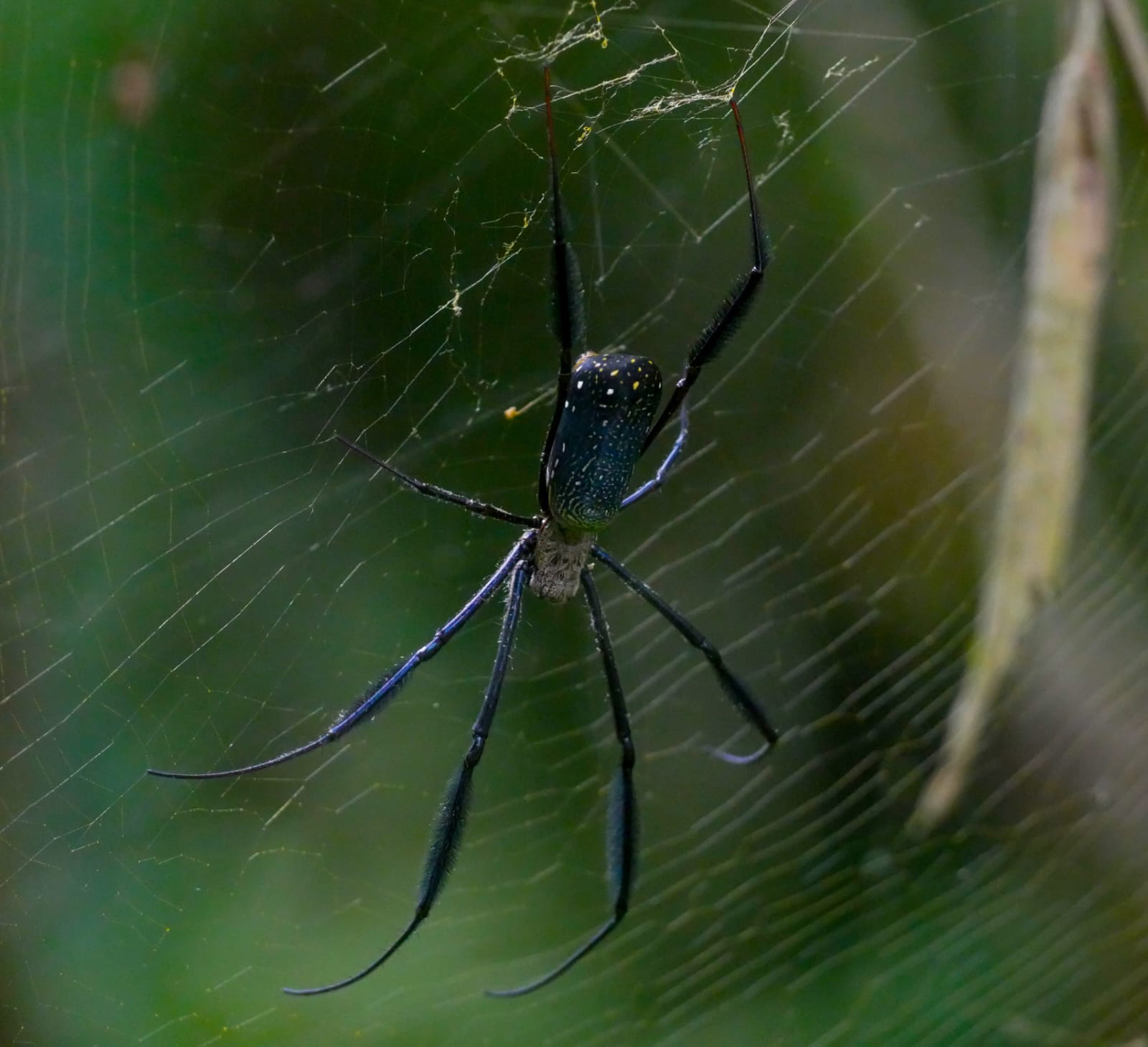
The Golden Orb Weaver
The Golden Orb Weaver (Trichonephila clavipes) is a very common spider found throughout São Tomé and Príncipe. While this species is native to the Americas, it was introduced to the islands long ago and is now a well-established part of the local ecosystem.
The Giant Baboon Spiders of São Tomé
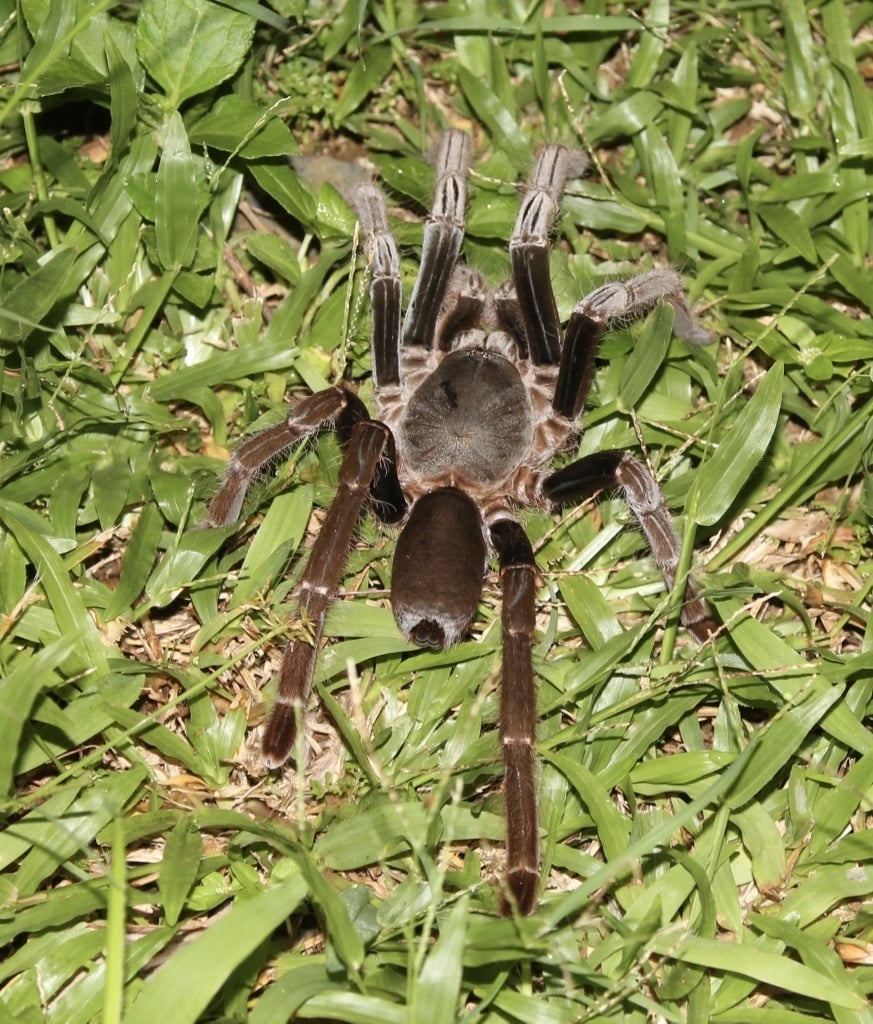
The most striking arachnids on the islands are the giant baboon spiders of the genus Hysterocrates. São Tomé has three known species, more than any other single island in the Gulf of Guinea. These are large, ground-dwelling spiders found in the forest, and in Africa they are known as baboon spiders rather than tarantulas, a name more commonly used for the related New World species. They are not aggressive toward humans and are rarely encountered unless you go looking for them, typically at night with a torch. For visiting naturalists, they are one of the highlights of the island's forest fauna.
The tarantulas of São Tomé are part of a broader pattern across the islands. Because these volcanic islands have been isolated from the African mainland for millions of years, many of the species that arrived here evolved in directions that would have been impossible on the continent. Spiders that are small on the mainland grew larger on the islands. Species that are widespread in Africa became restricted to a single peak or valley. That pattern of isolation and divergence runs through the entire arachnid fauna.
Should Visitors Worry
No. The only scorpion recorded on the oceanic islands is a small introduced species that is not considered dangerous. The whip spiders, despite looking dramatic, carry no venom at all. The tarantulas are shy and nocturnal. The vast majority of spiders on São Tomé and Príncipe are completely harmless to humans. There is nothing on these islands, in arachnid terms, that should give any visitor cause for concern. Standard tropical common sense applies: shake out shoes left on the floor, watch where you put your hands when scrambling over rocks, and you will be fine.
Two Centuries of Discovery
Scientists have been collecting and studying the arachnids of the Gulf of Guinea since the 1800s. The earliest collections were made by naturalists passing through on broader expeditions, picking up specimens alongside plants, birds, and fossils and shipping them back to museums in Europe. In the early 1900s, the French arachnologist Eugene Simon produced the first major catalogues of the region's spiders and scorpions, working largely from specimens collected by the Italian naturalist Leonardo Fea during two years on the islands.
For most of the twentieth century, research was sporadic. Specimens sat in museum drawers unstudied for decades. The average spider species from these islands has not been formally examined in over 80 years. More than a quarter of all described species are still known only from the single original specimen that was collected, sometimes over a century ago.
That began to change at the turn of the century. In 1998, the California Academy of Sciences conducted the first targeted arachnid survey in the Gulf of Guinea, on the nearby island of Bioko. A single expedition produced over 5,000 specimens representing 372 distinct forms, far exceeding everything that had been formally recorded from the island up to that point. The Academy has since led multiple collecting trips to São Tomé and Príncipe, bringing back material that researchers are still working through. New species have already been identified, and more are expected.
What Remains to Be Found
The honest answer is: a great deal. No standardised survey of the arachnid fauna of São Tomé and Príncipe has ever been completed. The methods that would reveal the full picture, beating vegetation, sifting leaf litter, setting traps, searching at night with ultraviolet light, have barely been applied here. Entire groups of arachnids known from mainland Africa appear to be absent from the islands, but whether that reflects genuine absence or simply a gap in collecting is an open question.
What is already clear is that these islands hold a spider and arachnid fauna unlike anywhere else in the region. Dozens of species are found only here. Many more are waiting to be formally described. For scientists, São Tomé and Príncipe remain one of the most promising and least explored arachnid frontiers in the world. For visitors walking through the Obo at night, torch in hand, the proof is all around you.