
Birdwatching
Birding inSão Tomé
Twenty-nine endemic bird species in a primary rainforest running its own evolutionary experiment for millions of years.
✦ The African Galapagos
One of the World's Most Concentrated Endemic Hotspots
São Tomé and Príncipe are oceanic islands. They were never connected to the African mainland. Over millions of years of volcanic isolation, species arrived by chance and then evolved in complete separation. The result is a level of endemic speciation that places these islands alongside the Galápagos in terms of what evolution can produce given time and isolation.
BirdLife's current country profile recognises at least 29 endemic bird species across the archipelago. This includes the Príncipe Scops-Owl, formally described as a new species in 2022, a discovery that underlines why serious ornithologists continue to regard these islands as globally significant.
For a birder, São Tomé is not a destination you visit because it is on the way to somewhere else. It is a destination in its own right, with a list of target species that cannot be seen anywhere else on Earth.

✦ Holy Grails
The Big Three
Many endemics are achievable in secondary forest and plantation landscapes. These three are different. They are tied to the hardest habitat on the island: primary rainforest in the deep south-west, specifically the remote river basins where access and visibility are limiting factors as much as the species themselves. Assume mud, humidity, and slow progress. They define the high-effort end of birding here.
Dwarf Ibis
Bostrychia bocagei
The bird most visiting birders travel specifically to see. Population estimates sit in the low hundreds, making every encounter genuinely significant. It is a classic rainforest skulker, more often hinted at by movement in the damp understorey than seen cleanly. The approach that works is patience, silence, and a skilled local tracker who knows its behaviour and micro-habitat. You will not find this bird alone.
Target the Rio Io Grande and Rio Xufexufe basins. Arrive early, move slowly, and treat any clear view as a privilege.
Habitat: Primary rainforest understorey, south-west river basins
São Tomé Grosbeak
Crithagra concolor
The world's largest canary. It disappeared from scientific view for over a century before being rediscovered in the modern era. Work led by Martim Melo and collaborators confirmed its status and cemented its extraordinary reputation. Its heavy bill and thick-set profile are textbook examples of island gigantism: what happens when a small finch evolves in isolation on an oceanic island with no competition. Even in the right habitat, most birders never see it.
This is a deep forest bird. No amount of effort guarantees a sighting. Build your birding trip around the south-west and treat the Grosbeak as the headline target, not a baseline expectation.
Habitat: Deep primary forest, south-west interior
São Tomé Fiscal
Lanius newtoni
The only shrike in the world restricted entirely to dense primary rainforest. Most shrikes are open-country birds that hunt from exposed perches. The São Tomé Fiscal has taken a different evolutionary path, sitting mid-canopy in complex habitat where low light and deep shadow work against the observer. It is one of the birds that makes the south-west feel genuinely otherworldly. Local knowledge of calls, movement patterns, and daily conditions is not optional at this level.
Call recognition matters more than optics here. A skilled local tracker with experience finding this species will do more for your chances than any amount of preparation alone.
Habitat: Dense primary rainforest, south-west
✦ Endemic Species
More Birds to Look For
Beyond the Big Three, the archipelago holds a long list of endemic species ranging from easily accessible to island-specific and demanding. This is not a complete checklist but a working guide to species most birding visitors target.
Giant Sunbird
Dreptes thomensis
Central highlands, Lagoa Amélia area
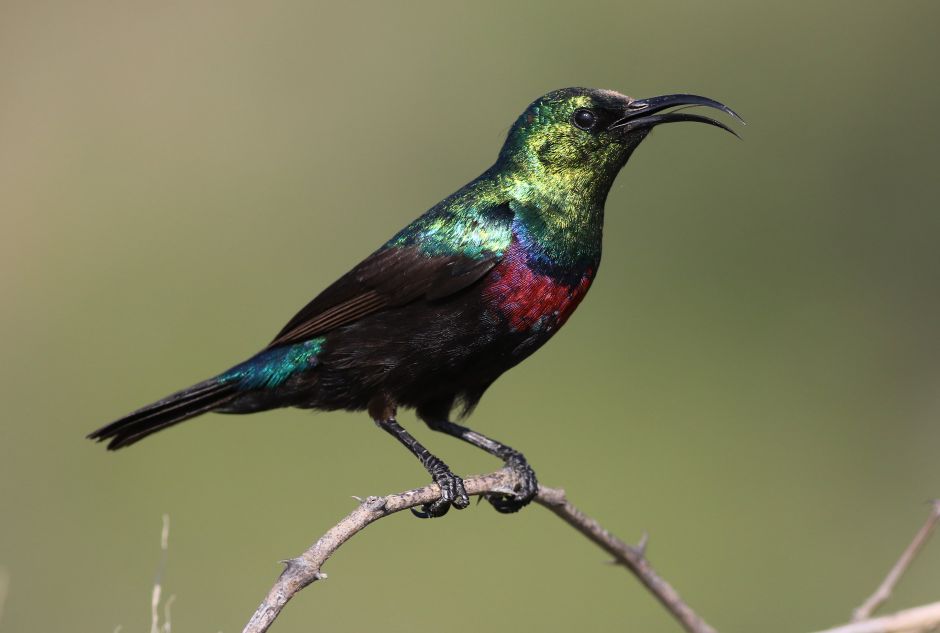
Large, bold, often active around flowering plants. One of the highlights of the Lagoa Amélia walk.
São Tomé Paradise Flycatcher
Terpsiphone atrochalybeia
Central highlands, forest edges
A genuine standout. The long tail streamers and iridescent plumage make it unmistakeable once seen. Often forages actively in secondary forest at mid-height.
São Tomé Speirops
Zosterops lugubris
Widespread in highland forest
Frequently moves through the canopy in noisy social groups. One of the easier endemics to connect with on a highland walk.
São Tomé Scops-Owl
Otus hartlaubi
Highland forest, Obo NP
Typically heard rather than seen, active after dusk in suitable forest habitat. The raucous 'kwow' call is distinctive once you know it. A night walk in the highlands is the standard approach.
São Tomé Kingfisher
Corythornis thomensis
Forest streams and rivers
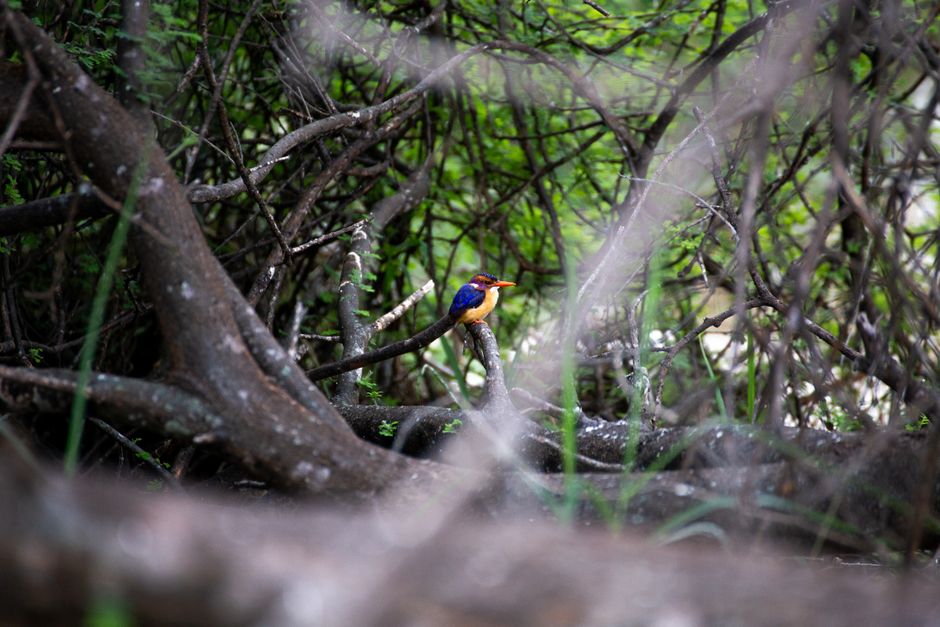
An island endemic with real field presence. Found along forested waterways across the island. The combination of electric-blue upper parts and rufous underside makes identification immediate.
São Tomé Oriole
Oriolus crassirostris
Forest canopy, plantation edges
Bold yellow and black plumage. Often heard before it is seen. Forages in the canopy of both primary and secondary forest.
Newton's Sunbird
Anabathmis newtonii
Lowland and mid-altitude forest
Named after the naturalists who first documented the island's avifauna. One of several endemic sunbirds, smaller and less obvious than the Giant Sunbird.
Príncipe Scops-Owl
Otus bikegila
Southern Príncipe forests
Formally described in 2022, this discovery reshaped modern understanding of the island's avifauna. Its call is a rapid, insect-like 'tuu'. A night walk in southern Príncipe is the standard search method.
Príncipe Kingfisher
Corythornis nais
Forest streams, Príncipe
A compact forest hunter with real field presence. Found along shaded waterways in Príncipe's interior. Easier to find than most of the island's other restricted-range species.
Príncipe Thrush
Turdus xanthorhynchus
Dark primary forest, southern Príncipe
Critically Endangered and tied closely to the darkest, wettest forest structure in intact southern areas. One of the most sought-after targets on Príncipe. Requires a guide with current knowledge of territories.
✦ Where to Bird
Key Birding Hotspots
The archipelago splits naturally into three birding zones: the accessible central highlands, the demanding south-west interior, and Príncipe. Each rewards a different approach and attracts a different subset of the endemic list.
Lagoa Amélia and the Central Highlands
São Tomé
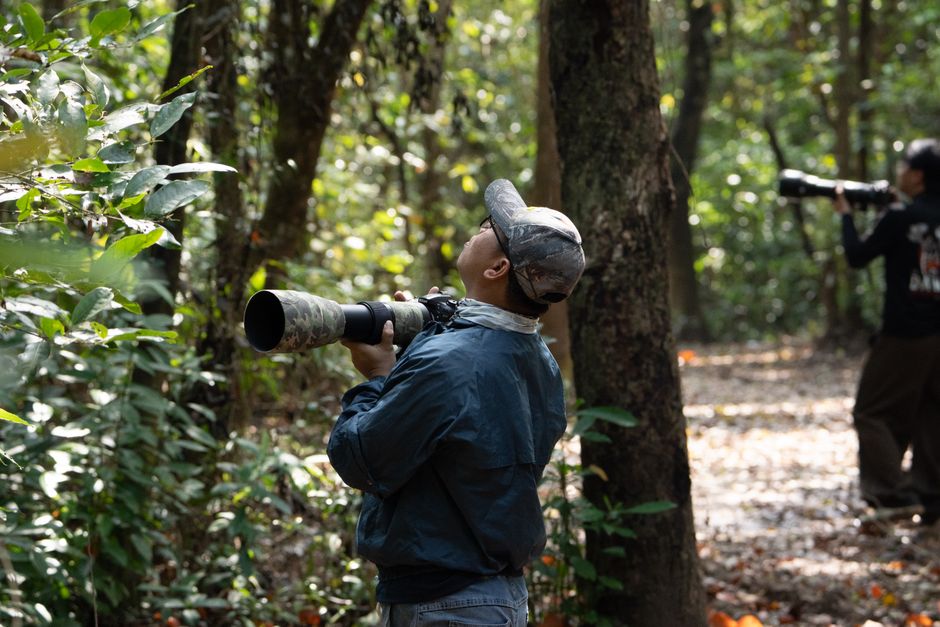
The classic entry point for highland endemics. The walk to Lagoa Amélia passes through cloud forest conditions and on a good day can stack several endemic species in a single morning. Giant Sunbird, São Tomé Speirops, São Tomé Paradise Flycatcher, and Newton's Sunbird are all regularly encountered here. The São Tomé Scops-Owl is most easily heard along this route after dark.
Logistics: Reachable by car from the city. A 4x4 is advisable but a standard vehicle manages the road in dry conditions. Allow a full day. Early starts matter for endemic activity.
Obo National Park Interior
São Tomé
The national park's interior reaches the volcanic peaks at the island's heart. This is primary forest birding with all the challenges that implies: canopy obstructions, humidity, variable light, and species that take time to locate. The reward is access to species that thin out rapidly in disturbed habitat. This is also the zone where serious birders begin to build lists that include species found nowhere else on Earth.
Logistics: Park entry is required. Guides familiar with the interior are strongly recommended. Plan for full days on foot in wet conditions.
The South-West: Rio Io Grande and Rio Xufexufe
São Tomé
This is where the Big Three live. The remote river basins of the south-west hold the highest density of critically endangered endemics on the island and the most demanding habitat. Access is slow, mud can be deep and persistent, and visibility in the forest is limited. This is not a casual day walk. The serious birder allocates multiple days, a 4x4, and an experienced local tracker for this area.
Logistics: A 4x4 is essential. The road deteriorates significantly in wet season. Most birding groups camp or use accommodation in the south and work the forest over several mornings.
Príncipe Southern Forests
Príncipe
Príncipe is smaller, older in geological terms, and in many ways wilder. Its southern forests hold a full set of Príncipe-only species: the newly described Príncipe Scops-Owl, the Príncipe Kingfisher, and the Critically Endangered Príncipe Thrush. The island receives far fewer visiting birders than São Tomé, which means species are less conditioned to human presence and encounters feel entirely unmediated.
Logistics: Príncipe requires a separate flight from São Tomé, adding time and logistics. Access into the south involves a guide. Given the rarity and isolation of some species, independent birding here without local knowledge is a genuine limiting factor.
✦ Timing
When to Go
Birding is viable year-round but the best vocal activity coincides with the return of the rains. eBird data and ground observation both show that endemic song, territorial display, and breeding behaviour increase from September through November. For the Big Three in the south-west, this window matters.
The main dry season, running roughly June to September, brings better physical access to the south-west roads and lower mud levels in the forest. The trade-off is reduced vocal activity and birds that are harder to locate without calls. Most serious birders try to align their visits with early October to catch peak activity alongside manageable access.
The short rains run roughly October to November. The long rains cover March to May. Both affect forest conditions and road access. Trips timed for late September are often the best compromise. Birding in the highlands remains productive throughout the year.
✦ Gear and Logistics
What to Bring
High humidity, dense canopy, and challenging terrain in the south-west mean your kit choices have real consequences. This is not a destination where anything will do.
Binoculars
8x42
Dense canopy and low light are the defining optical challenge on this island. 8x42 glasses with strong low-light performance do more here than a higher-magnification optic that loses brightness.
Waterproof boots
Ankle support essential
In the south-west, mud can be knee-deep and persistent. Good ankle support matters on uneven terrain. Trail runners are adequate for the highlands. For the south-west, proper waterproof hiking boots are not optional.
Rain gear
Lightweight and packable
Humidity is constant in the forest. A lightweight shell that packs small is more useful than a heavy waterproof. You will sweat. Accept it.
Camera and lens
300–500mm for serious photography
Most forest species are fast-moving and partially obscured. A longer focal length with image stabilisation is what separates a record shot from a missed opportunity.
Notebook
Waterproof paper ideally
Recording times, locations, behaviours, and conditions on paper has long-term value. ebird submissions are useful but a notebook on the ground catches detail that apps miss.
Getting Around the Island
A 4x4 is essential for serious birding in São Tomé. The central highlands roads are manageable with a standard vehicle in dry conditions, but the south-west requires proper clearance and four-wheel drive. Many of the most productive birding trailheads are only reachable after significant off-road driving.
For visiting birders without local contacts, hiring a car and arranging a local tracker separately is the standard approach. See our car hire page for vehicle options and practical advice on island roads. If you want to take the lead from someone who knows the forest, contact us directly about arranging a guided birding itinerary.
✦ Ethics
No Tape for
Rare Endemics
Playback is a standard birding tool in many destinations. São Tomé demands a different approach for its rarest species. The Dwarf Ibis, São Tomé Grosbeak, and São Tomé Fiscal all have critically small populations. Repeated playback disrupts territorial behaviour and breeding routines in ways that matter when a species is already hanging on by a thread.
The no-tape rule for these three species is not a suggestion or a preference. It is what responsible access to critically endangered wildlife looks like in practice. The joy of finding these birds comes precisely from the patience, skill, and field craft involved. Shortcutting that with playback removes what makes the encounter meaningful while adding real pressure to animals that cannot absorb it.
For all other endemics, use playback sparingly and never in breeding areas or near nests. Leave the forest as you found it.
✦ Common Questions
FAQ
✦ Plan Your Trip
Arrange a Birding Trip
Guided Birding Tours
We arrange guided birding itineraries focused on the Big Three and endemic species. Local trackers, 4x4 transport, and realistic planning for the south-west.
View tours →Car Hire
A 4x4 is essential for the south-west. Reliable vehicles with local support and advice on which routes hold the best access to primary forest.
Car hire options →Trip Planning Guide
Flights, visas, timing, and what to expect. Everything you need to plan a dedicated birding trip to São Tomé from scratch.
Read the guide →